

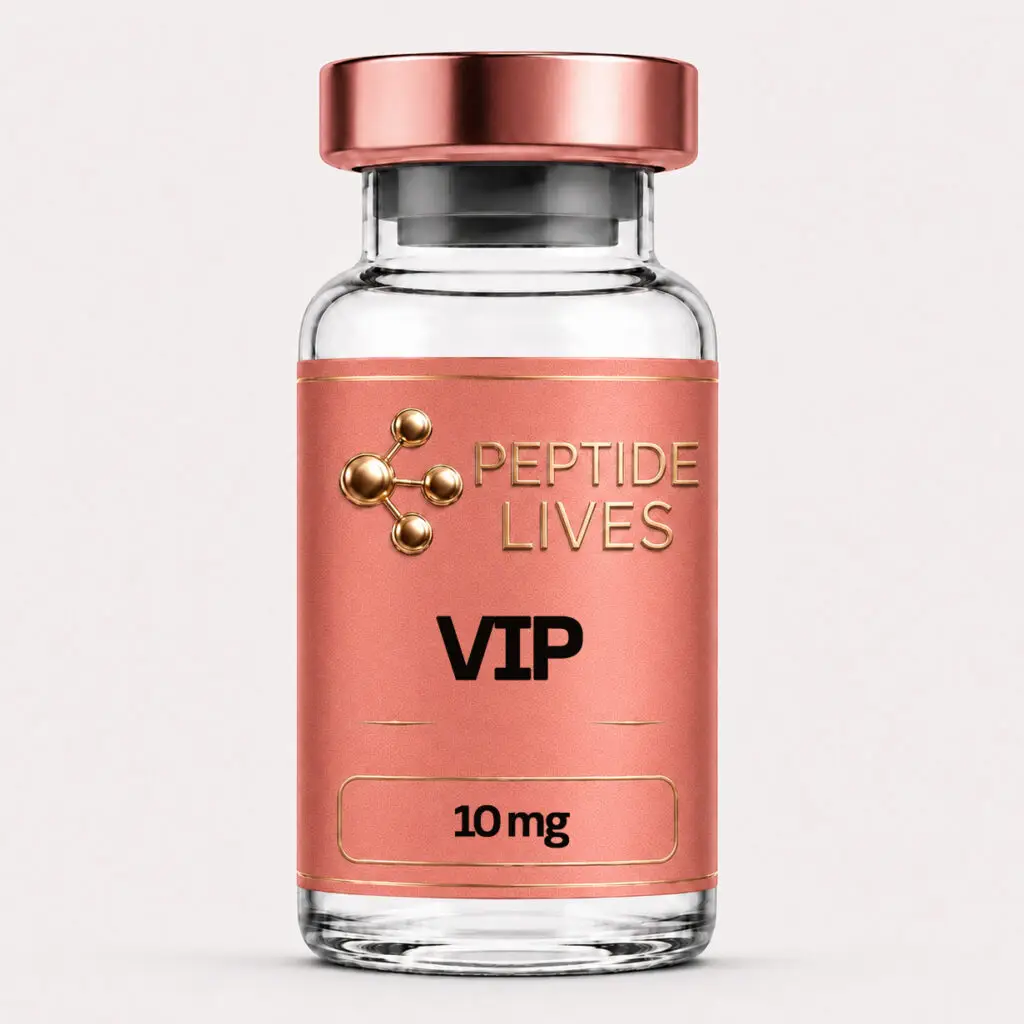
Description
VIP Technical Overview
Vasoactive Intestinal Peptide (VIP) is a naturally occurring 28-amino-acid neuropeptide belonging to the secretin/glucagon peptide superfamily.
VIP is distributed throughout the central and peripheral nervous systems and is involved in multiple physiological signaling pathways.
The peptide interacts primarily with the class B G protein-coupled receptors VPAC1 (VIPR1) and VPAC2 (VIPR2). These receptors participate in intracellular signaling pathways associated with cyclic adenosine monophosphate (cAMP) production.
VIP has attracted scientific interest in experimental research involving receptor pharmacology, neuroendocrine communication, gastrointestinal signaling, vascular smooth muscle responses, and immune-cell regulation.
Published studies have investigated VIP-associated signaling in cellular and animal models, as well as selected clinical research settings.
Compound Specifications
| Property | Value |
|---|---|
| Compound Name | Vasoactive Intestinal Peptide |
| Alternative Names | VIP, Aviptadil |
| Peptide Classification | Neuropeptide |
| Peptide Family | Secretin/Glucagon Superfamily |
| Amino Acid Sequence | HSDAVFTDNYTRLRKQMAVKKYLNSILN-NH2 |
| Sequence Length | 28 amino acid residues |
| Peptide Structure | Linear, C-terminal amidated peptide |
| Primary Receptor Targets | VPAC1 and VPAC2 |
| Secondary Receptor Interactions | Context-dependent interactions with related PACAP receptor systems |
| Source | Synthetic research preparation |
| Vial Content | 10mg |
| Research Category | Neuropeptide Research |
The sequence describes mature human VIP(1–28). The actual salt form, molecular identity, and peptide content should be verified using batch-specific analytical documentation.
Storage and Handling
- Store according to the manufacturer’s validated stability recommendations.
- Protect the peptide from moisture and unnecessary light exposure.
- Keep containers tightly sealed.
- Minimize unnecessary temperature fluctuations.
- Follow laboratory procedures appropriate for synthetic neuropeptides.
Lyophilized Format
VIP may be supplied in lyophilized (freeze-dried) form.
Lyophilization can support peptide stability by reducing moisture content under controlled manufacturing conditions.
The formulation and stability requirements of the supplied research material must be confirmed through manufacturer documentation.
Research Use Disclaimer
VIP research preparations are not intended for human or veterinary administration, diagnosis, or therapeutic use.
This specific Peptide Lives product is not represented as an FDA-approved pharmaceutical preparation.
Frequently Asked Questions
What Is VIP 10mg?
VIP 10mg is a research preparation of Vasoactive Intestinal Peptide, a naturally occurring 28-amino-acid neuropeptide.
What Is the Amino Acid Sequence of VIP?
The mature human VIP sequence is HSDAVFTDNYTRLRKQMAVKKYLNSILN-NH2.
What Are the Primary Receptor Targets?
VIP interacts primarily with VPAC1 and VPAC2 receptors.
What Research Areas Involve VIP?
Research includes neuroendocrine signaling, receptor pharmacology, gastrointestinal physiology, vascular signaling, and immune-cell regulation.
Is VIP the Same as PACAP?
No. VIP and pituitary adenylate cyclase-activating polypeptide (PACAP) are related members of the secretin/glucagon peptide superfamily but are distinct peptides.
Is VIP Approved for Human Use?
No FDA approval is established for this specific research preparation.
Research Overview
VIP was originally identified through investigations of gastrointestinal peptide activity and has subsequently been characterized as a widely distributed neuropeptide.
Its receptor-mediated effects have been studied in neuronal, endocrine, gastrointestinal, vascular, and immune-cell systems.
VIP activates VPAC receptors, which are primarily associated with Gs protein signaling and stimulation of adenylyl cyclase.
VPAC1 Receptor Research
VPAC1 is a class B G protein-coupled receptor activated by VIP.
Researchers investigate VPAC1-associated signaling to characterize intracellular responses involving cyclic AMP and related pathways.
VPAC2 Receptor Research
VPAC2 participates in cellular signaling in several tissue systems.
Experimental studies have investigated the distribution and activation of VPAC2 in neuronal and peripheral tissues.
cAMP Signaling Research
VIP-associated activation of VPAC receptors commonly stimulates adenylyl cyclase and intracellular cAMP production.
This pathway provides a model for investigating peptide-mediated G protein-coupled receptor signaling.
Gastrointestinal Research
VIP was originally characterized for its vasoactive properties in gastrointestinal physiology.
Research has examined its involvement in smooth muscle signaling, secretion, and enteric nervous system communication.
Immune-Cell Signaling Research
Experimental investigations have explored VIP-associated signaling in immune-cell populations and inflammatory response pathways.
These findings are context-dependent and do not establish therapeutic effectiveness for inflammatory or immune-mediated diseases.
Neuroendocrine Research
VIP participates in neural communication and has been investigated in experimental models involving hypothalamic signaling, circadian biology, and neuroendocrine regulation.
Research Applications
| Research Area | In Vitro Application |
|---|---|
| VPAC1 Research | Receptor activation and binding assays |
| VPAC2 Research | Cellular receptor signaling measurements |
| cAMP Signaling | Adenylyl cyclase pathway analysis |
| Neuroendocrine Research | Neuropeptide-associated cellular signaling |
| Gastrointestinal Research | Smooth muscle and secretory signaling models |
| Immune-Cell Research | Experimental inflammatory signaling pathways |
References
- Harmar AJ, Fahrenkrug J, Gozes I, et al. (2012). Pharmacology and Functions of Receptors for Vasoactive Intestinal Peptide and Pituitary Adenylate Cyclase-Activating Polypeptide: IUPHAR Review 1. British Journal of Pharmacology. View publication.
- Delgado M, Ganea D. (2013). Vasoactive Intestinal Peptide: A Neuropeptide with Pleiotropic Immune Functions. Amino Acids. Find scientific publication.
Certificate of Analysis (COA)
Researchers should review batch-specific analytical documentation confirming peptide identity, amino acid sequence, purity, molecular characteristics, and actual content.
For information about available documentation, contact Peptide Lives.

Reviews
There are no reviews yet.