

Description
ViLon Technical Overview
ViLon, also known as Vilon, Lys-Glu, or KE peptide, is a synthetic dipeptide composed of two amino acid residues: L-lysine and L-glutamic acid. It belongs to the Khavinson family of short peptide bioregulators, a class of compounds investigated for their interactions with cellular regulatory pathways.
ViLon is one of the simplest synthetic peptide bioregulators, consisting of only two amino acids connected by a single peptide bond. Its defined molecular structure makes it a subject of interest in studies examining peptide-DNA interactions, gene expression, immune-cell signaling, and cellular aging mechanisms.
Early laboratory investigations explored the activity of ViLon in thymocyte cultures and its relationship with sphingomyelin-mediated signaling. Subsequent research examined chromatin organization, cellular proliferation, and gene expression in experimental models.
Studies have also investigated ViLon in cultured lymphocytes obtained from older individuals, as well as in animal models examining age-associated biological processes.
These findings have contributed to scientific interest in the potential regulatory properties of short synthetic peptides. However, the biological mechanisms of ViLon remain incompletely understood, and its effects in humans have not been established through controlled clinical trials.
Compound Specifications
| Property | Value |
|---|---|
| Compound Name | ViLon |
| Chemical Name | L-Lysyl-L-glutamic acid |
| CAS Number | 45234-02-4 |
| PubChem CID | 7010502 |
| Molecular Formula | C₁₁H₂₁N₃O₅ |
| Molecular Weight | 275.30 g/mol |
| Amino Acid Sequence | H-Lys-Glu-OH |
| One-Letter Sequence | KE |
| Sequence Length | 2 amino acid residues |
| Peptide Structure | Linear dipeptide |
| Peptide Classification | Short Peptide Bioregulator |
| Source | Synthetic |
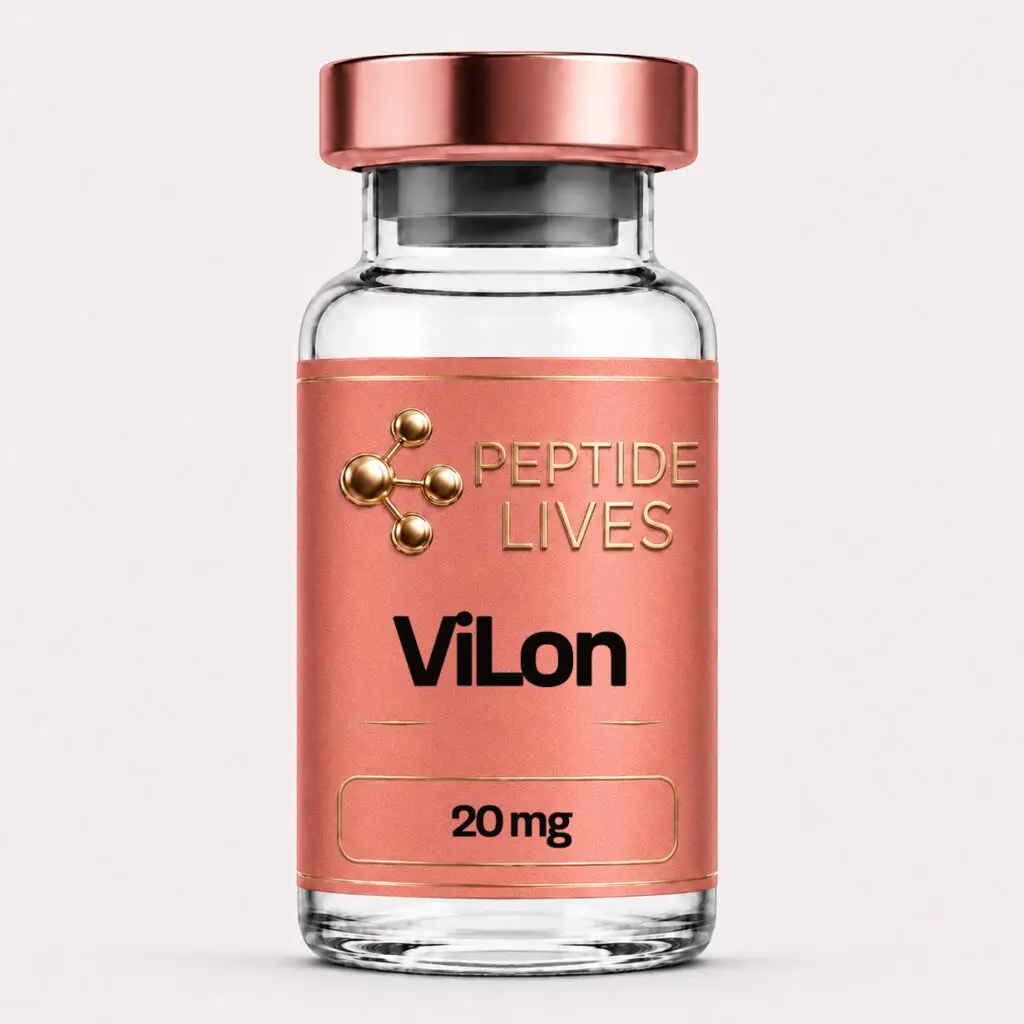
| Vial Content | 20mg |
Chemical Reference: PubChem — Lysylglutamic Acid (CID 7010502)
The listed molecular specifications correspond to the unmodified Lys-Glu dipeptide. Salt and hydrated forms may have different molecular compositions and molecular weights.
Storage and Handling
- Store ViLon according to the manufacturer’s recommended temperature and stability conditions.
- Keep the research material tightly sealed and protected from moisture and direct light.
- Minimize exposure to unnecessary temperature fluctuations during laboratory storage.
- Avoid repeated freeze-thaw cycles when handling prepared research solutions.
- Follow established laboratory handling procedures to maintain compound integrity.
Lyophilized Format
ViLon may be supplied in lyophilized (freeze-dried) form for laboratory research.
Lyophilization reduces moisture content and can support peptide stability under appropriate storage conditions.
The stability of ViLon depends on its chemical form, formulation, packaging, and environmental conditions. Researchers should consult manufacturer-provided documentation for batch-specific storage and handling requirements.
Research Use Disclaimer
ViLon is supplied exclusively for laboratory research purposes.
This compound is not intended for human or veterinary consumption, clinical use, diagnostic applications, or therapeutic administration.
ViLon is not an FDA-approved drug, dietary supplement, or cosmetic product.
Peptide Lives supplies ViLon solely for legitimate scientific research.
Frequently Asked Questions
What Is ViLon 20mg?
ViLon 20mg is a synthetic dipeptide consisting of L-lysine and L-glutamic acid. It belongs to the family of short peptide bioregulators investigated in experimental research involving immune-cell signaling, chromatin organization, and cellular regulatory processes.
What Is the Amino Acid Sequence of ViLon?
The amino acid sequence of ViLon is H-Lys-Glu-OH, commonly abbreviated as KE.
It consists of two amino acid residues connected by a peptide bond.
What Are the CAS Number and Molecular Weight of ViLon?
ViLon has CAS number 45234-02-4 and a molecular weight of approximately 275.30 g/mol.
Its molecular formula is C₁₁H₂₁N₃O₅.
How Should ViLon Be Stored?
ViLon should be stored according to the manufacturer’s recommended temperature and stability conditions.
The compound should remain protected from moisture, direct light, and unnecessary temperature fluctuations.
What Research Areas Involve ViLon?
ViLon has been investigated in laboratory research involving thymocyte proliferation, immune-cell signaling, chromatin organization, gene expression, and cellular aging models.
What Is the Difference Between ViLon and Thymogen?
ViLon and Thymogen are distinct synthetic dipeptides.
ViLon consists of Lys-Glu (KE), while Thymogen consists of Glu-Trp (EW).
Both have been investigated in peptide bioregulation research, but their molecular structures and experimental research profiles differ.
Is ViLon Approved for Human Use?
No. ViLon is not FDA-approved for human therapeutic use.
Peptide Lives supplies ViLon exclusively for laboratory research purposes.
ViLon Research
ViLon has been investigated in laboratory studies examining immune-cell regulation, chromatin structure, gene expression, and age-associated cellular changes.
Early experimental research focused on the activity of short peptide bioregulators in thymic tissue and lymphocyte cultures. Subsequent investigations explored their potential interactions with intracellular signaling pathways and mechanisms involved in cellular aging.
Published research has reported biological responses to ViLon in selected cell cultures and animal models. These observations provide a basis for further investigation but do not establish therapeutic activity in humans.
Thymocyte Proliferation and Immune Signaling
Thymocytes are developing T lymphocytes involved in the formation of the adaptive immune system.
A study published in 2002 investigated ViLon alongside Epithalon and Cortagen in mouse thymocyte cultures.
Researchers reported that ViLon demonstrated co-mitogenic activity in thymocyte proliferation assays and influenced cellular responses associated with interleukin-1 beta.
The study also examined changes in sphingomyelinase activity, suggesting a possible relationship between ViLon exposure and membrane-associated signaling pathways.
These findings support continued investigation into the interaction between short peptides and immune-cell regulatory mechanisms.
Chromatin Organization and Gene Expression
Chromatin consists of DNA and associated proteins that organize genetic material within the cell nucleus.
Changes in chromatin organization can influence gene accessibility and transcriptional activity.
Research involving ViLon has examined chromatin structure in cultured lymphocytes obtained from older individuals.
Experimental studies reported changes in chromatin condensation and selected measures of gene activity following exposure to short peptide bioregulators.
These observations have contributed to hypotheses concerning the possible involvement of short peptides in epigenetic regulatory mechanisms.
However, the precise molecular interactions responsible for these effects remain incompletely characterized.
Peptide-DNA Interaction Research
Short peptides have been investigated for their potential interactions with DNA and chromatin-associated structures.
ViLon, with its minimal Lys-Glu sequence, has been included in research examining how peptide structure may influence molecular interactions.
Computational and experimental studies involving short peptide bioregulators have explored possible relationships between peptide sequences, DNA recognition, and cellular regulatory responses.
Such findings remain exploratory. Computational binding models do not independently establish direct DNA regulation in living organisms.
Cellular Aging Research
ViLon has been investigated in experimental models examining biological processes associated with aging.
Research has included studies of chromatin organization, cellular proliferation, immune-cell activity, and gene expression.
An animal study published in 2000 examined ViLon in mice and reported changes in spontaneous tumor development and lifespan under specific experimental conditions.
These findings have attracted scientific interest in peptide bioregulation and aging-related research.
However, results from animal models cannot establish that ViLon extends human lifespan, prevents cancer, or reverses biological aging.
Inflammatory Signaling Research
ViLon has been included in experimental investigations examining cellular signaling pathways associated with inflammatory responses.
Studies involving immune-cell models have explored changes in proliferation-related signaling and the expression of inflammatory mediators following exposure to short peptide compounds.
These investigations contribute to understanding potential relationships between peptide structure and cellular signaling.
The available evidence does not establish that ViLon provides clinically meaningful anti-inflammatory effects in humans.
Oxidative Stress Research
Reactive oxygen species participate in cellular signaling and oxidative stress responses.
ViLon has been examined in experimental models evaluating reactive oxygen species generation in different cellular compartments.
Research involving Drosophila subcellular fractions reported differing responses between mitochondrial and cytosolic preparations.
These results indicate that the observed effects depend on experimental conditions and cellular context.
They do not establish ViLon as a general antioxidant compound.
Research Applications
| Research Area | Laboratory Research Focus |
|---|---|
| Immune-Cell Signaling | Experimental analysis of thymocyte and lymphocyte responses |
| Chromatin Research | Investigation of chromatin organization and gene accessibility |
| Gene Expression | Studies of transcription-related cellular processes |
| Peptide-DNA Interactions | Molecular modeling and structure-interaction research |
| Cellular Aging | Investigation of age-associated cellular mechanisms |
| Inflammatory Signaling | Experimental analysis of immune-cell signaling pathways |
| Oxidative Stress | Reactive oxygen species generation in laboratory models |
| Peptide Bioregulation | Structure-activity relationships of short synthetic peptides |
Scientific References
-
Khavinson V.K. et al. (2002).
Effects of Short Peptides on Thymocyte Blast Transformation and Signal Transduction Along the Sphingomyelin Pathway.
Bulletin of Experimental Biology and Medicine.
View Scientific Publication -
Lezhava T. et al. (2006).
Anti-Aging Peptide Bioregulators Induce Reactivation of Chromatin.
Georgian Medical News.
View Scientific Publication -
Khavinson V.K., Anisimov V.N. (2000).
A Synthetic Dipeptide Vilon (L-Lys-L-Glu) Inhibits Growth of Spontaneous Tumors and Increases Life Span of Mice.
Doklady Biological Sciences.
View Scientific Publication
Research Evidence Note: The referenced publications describe experimental findings from cell cultures and animal models. They do not establish the clinical safety or effectiveness of ViLon in humans.
Certificate of Analysis (COA)
A Certificate of Analysis (COA) provides analytical information about a research compound, including its identity, purity, and other measured characteristics.
Depending on the analytical procedures performed, batch-specific documentation may include high-performance liquid chromatography (HPLC) and mass spectrometry (MS) results.
Researchers should review available batch-specific analytical documentation to verify compound identity and assess whether the material meets their experimental requirements.
For information about available ViLon analytical documentation, contact Peptide Lives.
Peptide Lives
Website: https://peptidelives.com

Reviews
There are no reviews yet.