

Description
Retatrutide + Cagrilintide Technical Overview
Retatrutide and Cagrilintide are synthetic peptide compounds investigated in research involving distinct metabolic and endocrine signaling pathways.
Retatrutide, also known as LY3437943, is a modified peptide developed as an agonist of three G protein-coupled receptors: the glucagon-like peptide-1 receptor (GLP-1R), glucose-dependent insulinotropic polypeptide receptor (GIPR), and glucagon receptor (GCGR).
Its triple receptor activity distinguishes it from compounds that selectively activate one or two of these receptor systems.
Cagrilintide, also known as AM833, is a long-acting, lipidated analogue of the pancreatic hormone amylin. Its molecular structure has been modified to extend its pharmacological activity compared with native amylin.
Amylin receptor signaling is involved in physiological processes associated with gastrointestinal function, satiety, and metabolic regulation.
Retatrutide and Cagrilintide therefore represent two different approaches to investigating peptide-mediated endocrine signaling.
Retatrutide has been evaluated in clinical research involving metabolic regulation and body-weight-related outcomes. Cagrilintide has been independently investigated in clinical studies involving amylin receptor pharmacology and metabolic outcomes.
However, published findings from these separate research programs do not establish the pharmacological behavior, stability, safety, or efficacy of a combined Retatrutide–Cagrilintide formulation.
Compound Information
| Property | Retatrutide | Cagrilintide |
|---|---|---|
| Compound Name | Retatrutide | Cagrilintide |
| Alternative Names | LY3437943 | AM833 |
| CAS Number | 2381089-83-2 | 1415456-99-3 |
| Chemical Classification | Modified synthetic peptide | Lipidated amylin analogue |
| Primary Receptor Targets | GLP-1R, GIPR, GCGR | Amylin receptor complexes |
| Research Category | Metabolic and endocrine research | Amylin signaling research |
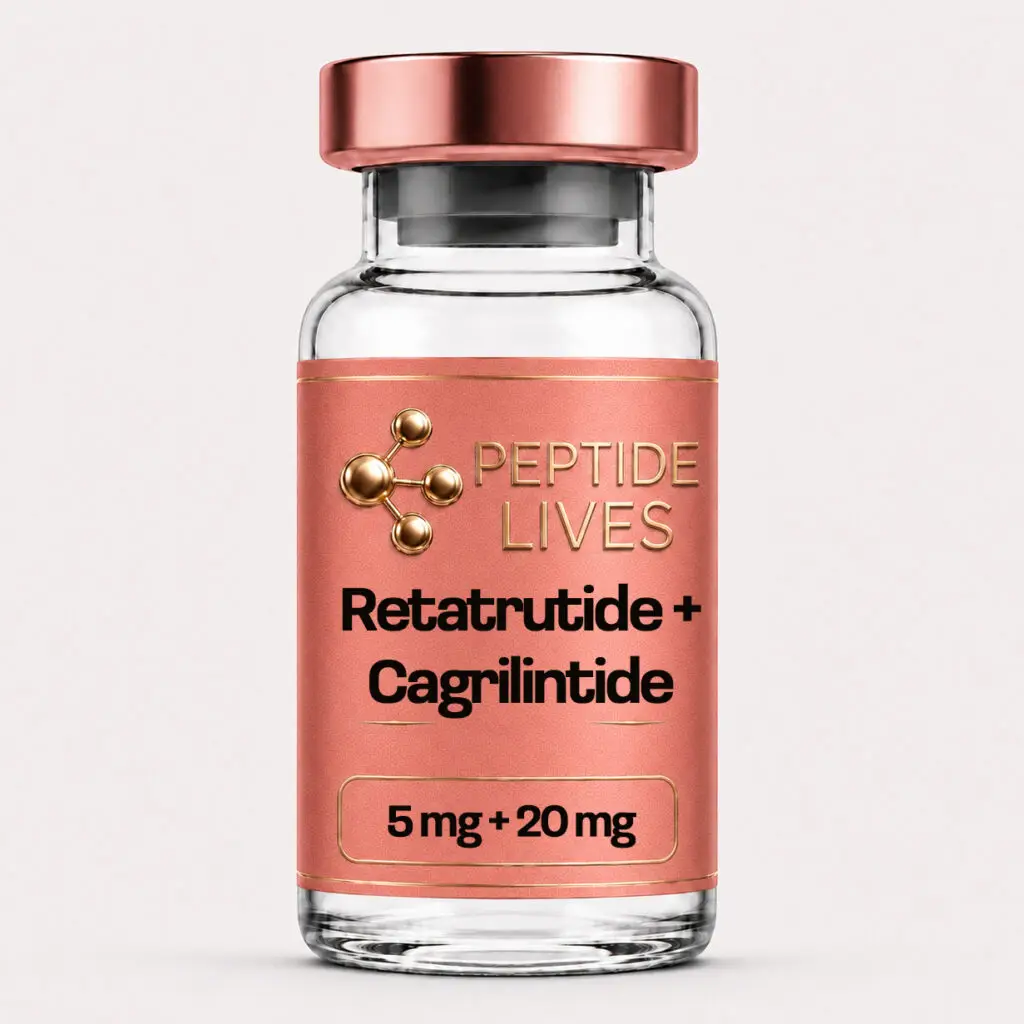
| Listed Quantity | 5mg | 20mg |
Chemical references:
The listed quantities describe the product’s stated contents. They do not independently establish whether the compounds are supplied together in one vial or separately.
Cagrilintide Molecular Specifications
| Property | Value |
|---|---|
| CAS Number | 1415456-99-3 |
| PubChem CID | 171397054 |
| Molecular Formula | C₁₉₄H₃₁₂N₅₄O₅₉S₂ |
| Molecular Weight | Approximately 4409 g/mol |
| Peptide Classification | Long-acting amylin analogue |
| Structural Characteristics | Lipidated peptide with intramolecular disulfide bonding |
The molecular formula and molecular weight describe the registered Cagrilintide structure. Salt forms may have different analytical characteristics. PubChem
Retatrutide Molecular Specifications
| Property | Value |
|---|---|
| CAS Number | 2381089-83-2 |
| Alternative Name | LY3437943 |
| Peptide Classification | Triple receptor agonist |
| Receptor Targets | GLP-1R, GIPR, GCGR |
| Structural Characteristics | Chemically modified, lipidated peptide |
Retatrutide chemical identity is referenced in PubChem and pharmaceutical research literature. The exact salt form and molecular specifications of the supplied material require confirmation against its analytical documentation. PubChem
Storage and Handling
- Store each compound according to its manufacturer-provided stability documentation.
- Protect research materials from excessive moisture, direct light, and temperature fluctuations.
- Use handling procedures appropriate for the verified physical form and composition.
- Avoid assuming that stability data for either individual compound apply to a combined preparation.
- Verify formulation compatibility and analytical stability before using a combined material in laboratory experiments.
Lyophilized Format
Retatrutide and Cagrilintide may be supplied as lyophilized research materials.
Lyophilization is a dehydration process used in peptide manufacturing to reduce moisture content and support stability under appropriate conditions.
The stability of individual peptides depends on their molecular structure, formulation, packaging, and environmental exposure.
For a preparation containing more than one peptide, additional stability and compatibility considerations may apply.
The physical form and stability of the specific Retatrutide–Cagrilintide product should be established through manufacturer documentation and formulation-specific analytical testing.
Research Use Disclaimer
Retatrutide and Cagrilintide are investigational compounds and are not FDA-approved for human therapeutic use.
They have not been established as safe or effective when administered together.
This material is described exclusively for laboratory research purposes and is not intended for human or veterinary consumption, clinical use, diagnostic applications, or therapeutic administration.
Research-use labeling does not independently establish regulatory compliance.
RETATRUTIDE + CAGRILINTIDE RESEARCH
Retatrutide and Cagrilintide have been investigated through separate pharmaceutical research programs examining metabolic and endocrine signaling.
Retatrutide is characterized by its ability to activate GLP-1, GIP, and glucagon receptors.
Cagrilintide belongs to the class of long-acting amylin analogues, which interact with receptor systems distinct from those targeted by Retatrutide.
The two compounds are therefore relevant to investigations comparing incretin, glucagon, and amylin signaling.
Clinical research has evaluated Retatrutide independently, including a randomized phase 2 trial published in The New England Journal of Medicine in 2023.
Cagrilintide has also been evaluated independently, including a randomized phase 2 trial published in The Lancet in 2021.
These studies provide information about the individual compounds but cannot establish the properties of their combination. New England Journal of Medicine
Triple Receptor Signaling Research
Retatrutide acts as an agonist at three receptors involved in endocrine and metabolic regulation.
GLP-1R, GIPR, and GCGR participate in distinct but interconnected signaling pathways.
Experimental and clinical pharmacology investigations have characterized the activity of Retatrutide across these receptor systems.
The compound is of scientific interest because it allows researchers to examine simultaneous activation of three hormonal signaling pathways.
Amylin Receptor Research
Cagrilintide is a synthetic, long-acting analogue of amylin.
Amylin is a pancreatic peptide hormone involved in physiological processes associated with food intake, gastrointestinal function, and metabolic regulation.
Amylin receptor complexes involve the calcitonin receptor and receptor activity-modifying proteins.
Cagrilintide has been investigated as a pharmacological tool for studying these pathways.
Metabolic Signaling Research
Retatrutide and Cagrilintide interact with different receptor systems involved in metabolic regulation.
Retatrutide research focuses on the combined pharmacology of GLP-1, GIP, and glucagon receptors.
Cagrilintide research investigates signaling associated with amylin receptor activation.
Their distinct molecular targets provide a basis for comparing endocrine signaling mechanisms.
However, a combination of these compounds cannot be assumed to produce additive or synergistic effects without direct experimental evidence.
Receptor Interaction Research
Research involving multiple signaling compounds requires consideration of receptor selectivity, downstream cellular responses, and pharmacological interactions.
Retatrutide has been characterized as a triple receptor agonist.
Cagrilintide interacts with amylin receptor systems.
The independent receptor profiles of these compounds are established areas of scientific investigation.
Specific interactions resulting from their combined exposure require separate experimental evaluation.
Formulation Compatibility Research
Combined peptide formulations introduce physicochemical questions that are not necessarily relevant to individual compounds.
Potential areas of investigation include chemical stability, peptide aggregation, adsorption, and formulation-dependent degradation.
The stability of Retatrutide alone does not establish its stability when formulated with Cagrilintide.
Likewise, published Cagrilintide stability data cannot automatically be applied to a combined preparation.
Product-specific analytical data are necessary to characterize the composition and stability of such a formulation.
Research Applications
| Research Area | Laboratory Research Focus |
|---|---|
| GLP-1 Receptor Research | GLP-1R signaling mechanisms |
| GIP Receptor Research | GIPR-mediated endocrine signaling |
| Glucagon Receptor Research | GCGR activation and downstream signaling |
| Amylin Receptor Research | Amylin receptor pharmacology |
| Metabolic Signaling | Comparison of endocrine signaling pathways |
| Receptor Pharmacology | Characterization of individual receptor responses |
| Peptide Stability | Physicochemical stability assessment |
| Formulation Research | Compatibility and analytical characterization |
FREQUENTLY ASKED QUESTIONS
What Is Retatrutide 5mg + Cagrilintide 20mg?
Retatrutide 5mg + Cagrilintide 20mg is a research product listing two synthetic peptide compounds with different receptor targets.
Retatrutide is a triple agonist of GLP-1, GIP, and glucagon receptors. Cagrilintide is a long-acting amylin analogue.
Both compounds have been studied independently in metabolic and endocrine research.
What Are the CAS Numbers of Retatrutide and Cagrilintide?
Retatrutide has CAS number 2381089-83-2.
Cagrilintide has CAS number 1415456-99-3.
These identifiers refer to the respective chemical compounds, not to a new chemical entity formed by combining them.
What Is the Difference Between Retatrutide and Cagrilintide?
Retatrutide activates GLP-1, GIP, and glucagon receptors.
Cagrilintide is an amylin analogue that interacts with amylin receptor systems.
These distinct receptor profiles are relevant to research investigating endocrine signaling.
Has the Retatrutide and Cagrilintide Combination Been Clinically Studied?
Published clinical trials have investigated Retatrutide and Cagrilintide independently.
The available evidence does not establish the safety, efficacy, or pharmacological effects of their combined use.
How Should Retatrutide and Cagrilintide Be Stored?
Storage conditions should follow the manufacturer’s verified stability documentation.
For combined preparations, individual compound stability data may not accurately predict the stability of the mixture.
What Research Areas Involve These Compounds?
Retatrutide and Cagrilintide have been investigated in research involving incretin signaling, glucagon receptor activity, amylin receptor pharmacology, endocrine regulation, and metabolic pathways.
Are Retatrutide and Cagrilintide FDA-Approved?
Neither Retatrutide nor Cagrilintide is FDA-approved in the United States.
Their combined formulation is not an FDA-approved medication and has not been established as safe or effective for human use.
SCIENTIFIC REFERENCES
1. Jastreboff A.M. et al. (2023)
Triple–Hormone-Receptor Agonist Retatrutide for Obesity — A Phase 2 Trial.
New England Journal of Medicine, 389, 514–526.
https://doi.org/10.1056/NEJMoa2301972
2. Rosenstock J. et al. (2023)
Retatrutide, a GIP, GLP-1 and Glucagon Receptor Agonist, for People with Type 2 Diabetes: A Randomised, Double-Blind, Placebo and Active-Controlled, Parallel-Group, Phase 2 Trial Conducted in the USA.
The Lancet, 402, 529–544.
https://doi.org/10.1016/S0140-6736(23)01053-X
3. Lau D.C.W. et al. (2021)
Once-Weekly Cagrilintide for Weight Management in People with Overweight and Obesity: A Multicentre, Randomised, Double-Blind, Placebo-Controlled and Active-Controlled, Dose-Finding Phase 2 Trial.
The Lancet, 398, 2160–2172.
https://doi.org/10.1016/S0140-6736(21)01751-7
Research evidence note: These publications investigate the individual compounds. None establishes the safety, effectiveness, or stability of the specific Retatrutide 5mg + Cagrilintide 20mg combination.
CERTIFICATE OF ANALYSIS (COA)
A Certificate of Analysis (COA) provides analytical information about a research compound, including its identity, purity, and measured characteristics.
For a product containing Retatrutide and Cagrilintide, analytical documentation should identify both compounds and verify their respective quantities.
Where applicable, additional testing may be needed to characterize formulation stability and compatibility.
Testing results for individual peptide batches do not automatically verify a combined preparation.
For information about available analytical documentation, contact:
Peptide Lives
Website: https://peptidelives.com

Reviews
There are no reviews yet.