

Description
L-Carnitine Technical Overview
L-Carnitine, also known as levocarnitine, is a naturally occurring quaternary ammonium compound involved in mitochondrial fatty acid metabolism. It is synthesized from amino-acid precursors and participates in the transport of long-chain fatty acyl groups into the mitochondrial matrix.
The carnitine transport system includes carnitine palmitoyltransferase 1 (CPT1), carnitine-acylcarnitine translocase (CACT), and carnitine palmitoyltransferase 2 (CPT2). Together, these components facilitate the movement of long-chain fatty acyl groups across the mitochondrial membranes.
L-Carnitine is investigated in biochemical research involving fatty acid oxidation, acylcarnitine formation, mitochondrial energy metabolism, and cellular metabolic regulation.
Compound Specifications
| Property | Value |
|---|---|
| Compound Name | L-Carnitine |
| Alternative Name | Levocarnitine |
| CAS Number | 541-15-1 |
| PubChem CID | 10917 |
| Molecular Formula | C7H15NO3 |
| Molecular Weight | 161.20 g/mol |
| Compound Classification | Quaternary ammonium compound |
| Peptide Sequence | Not applicable |
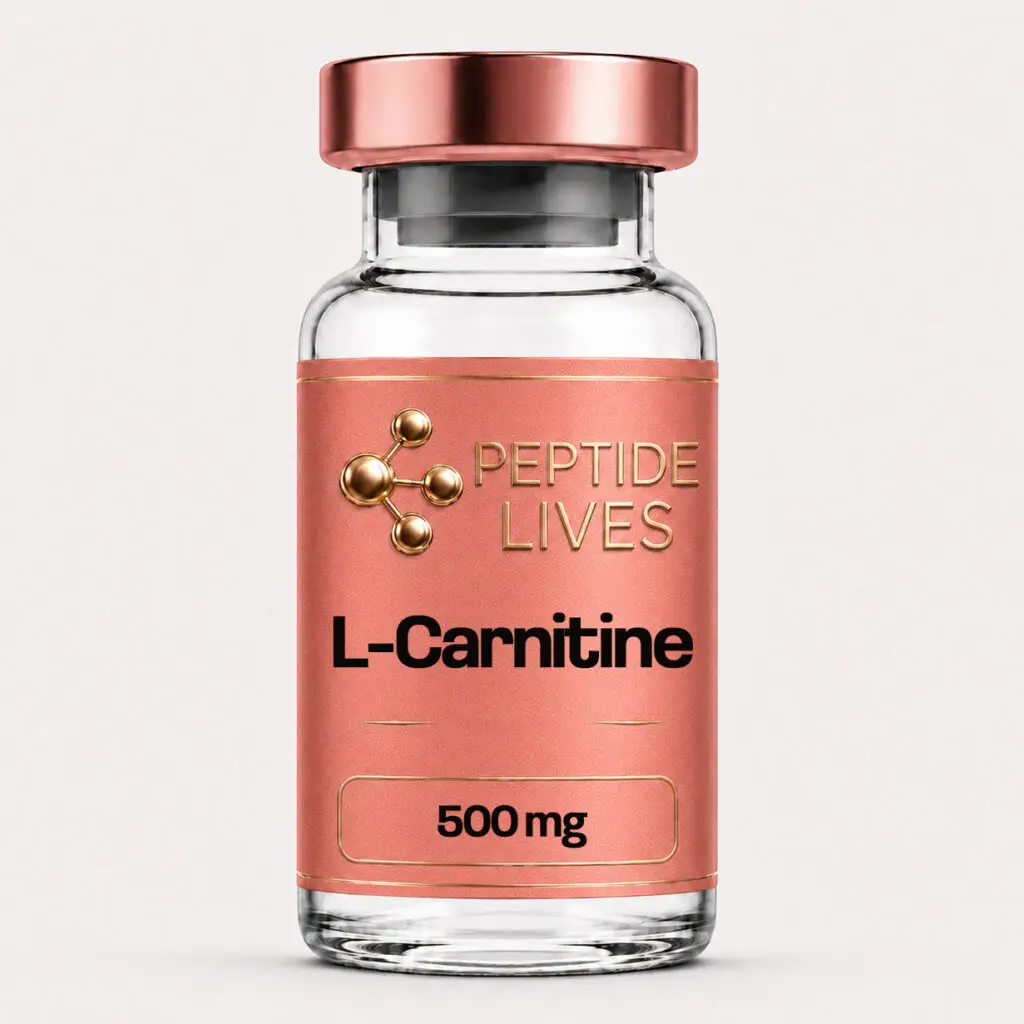
| Listed Volume | 10mL |
| Listed Content | 500mg — concentration requires verification |
| Research Category | Metabolic Research |
The chemical specifications describe L-Carnitine rather than a particular formulated solution. The precise concentration and total compound content must be verified against the product label.
Storage and Handling
- Follow the manufacturer’s validated storage conditions for the supplied formulation.
- Keep the container securely closed and protected from contamination.
- Protect the preparation from unnecessary temperature fluctuations.
- Use appropriate analytical and laboratory handling procedures.
Lyophilized Format
L-Carnitine may be manufactured in different physical forms, including solid and liquid preparations. The listed 10mL product appears to describe a liquid formulation; lyophilization should not be claimed unless confirmed by the manufacturer.
Research Use Disclaimer
This specific Peptide Lives preparation is described for laboratory research only and is not represented as an FDA-approved pharmaceutical product. FDA approval of other levocarnitine-containing medicines does not extend to this preparation. Not intended for human or veterinary administration.
Frequently Asked Questions
What Is L-Carnitine?
L-Carnitine is a naturally occurring compound involved in mitochondrial transport of long-chain fatty acyl groups.
What Are Its CAS Number and Molecular Weight?
L-Carnitine has CAS number 541-15-1 and a molecular weight of approximately 161.20 g/mol.
Is L-Carnitine a Peptide?
No. L-Carnitine is a small organic molecule rather than a peptide.
What Research Areas Involve L-Carnitine?
Research areas include mitochondrial fatty acid oxidation, acylcarnitine metabolism, metabolic transport, and cellular energy pathways.
How Should L-Carnitine Be Stored?
Storage requirements depend on the concentration, formulation, and packaging. Researchers should consult the manufacturer’s stability documentation.
Research Overview
L-Carnitine is an essential component of the mitochondrial carnitine shuttle involved in long-chain fatty acid oxidation. Its established biochemical function makes it relevant to research examining mitochondrial substrate transport and energy metabolism.
Mitochondrial Fatty Acid Transport Research
The carnitine shuttle transfers long-chain fatty acyl groups across the inner mitochondrial membrane. CPT1 produces acylcarnitines, CACT transports them across the membrane, and CPT2 regenerates fatty acyl-CoA inside the mitochondrial matrix.
Acylcarnitine Metabolism Research
Acylcarnitines are important intermediates and analytical markers in studies of fatty acid oxidation. Their profiles can provide information about metabolic pathway activity under defined experimental conditions.
Cellular Energy Research
Researchers investigate L-Carnitine-associated pathways to understand the contribution of fatty acid oxidation to cellular energy production.
Research Applications
| Research Area | In Vitro Application |
|---|---|
| Carnitine Shuttle | Investigation of CPT1, CACT, and CPT2 transport mechanisms |
| Fatty Acid Oxidation | Analysis of mitochondrial beta-oxidation pathways |
| Acylcarnitine Metabolism | Metabolite profiling and biochemical assays |
| Energy Metabolism | Studies of mitochondrial substrate utilization |
References
- Longo N, Frigeni M, Pasquali M. (2016). Carnitine transport and fatty acid oxidation. Biochimica et Biophysica Acta. DOI: 10.1016/j.bbalip.2016.01.023
- PubChem. L-Carnitine, CID 10917. Chemical compound record.
Certificate of Analysis (COA)
Batch-specific documentation should establish the formulation, compound identity, concentration, total content, and relevant quality characteristics.
Researchers may contact Peptide Lives to request available analytical documentation for the supplied lot.
Peptide Lives
peptidelives.com

Reviews
There are no reviews yet.