

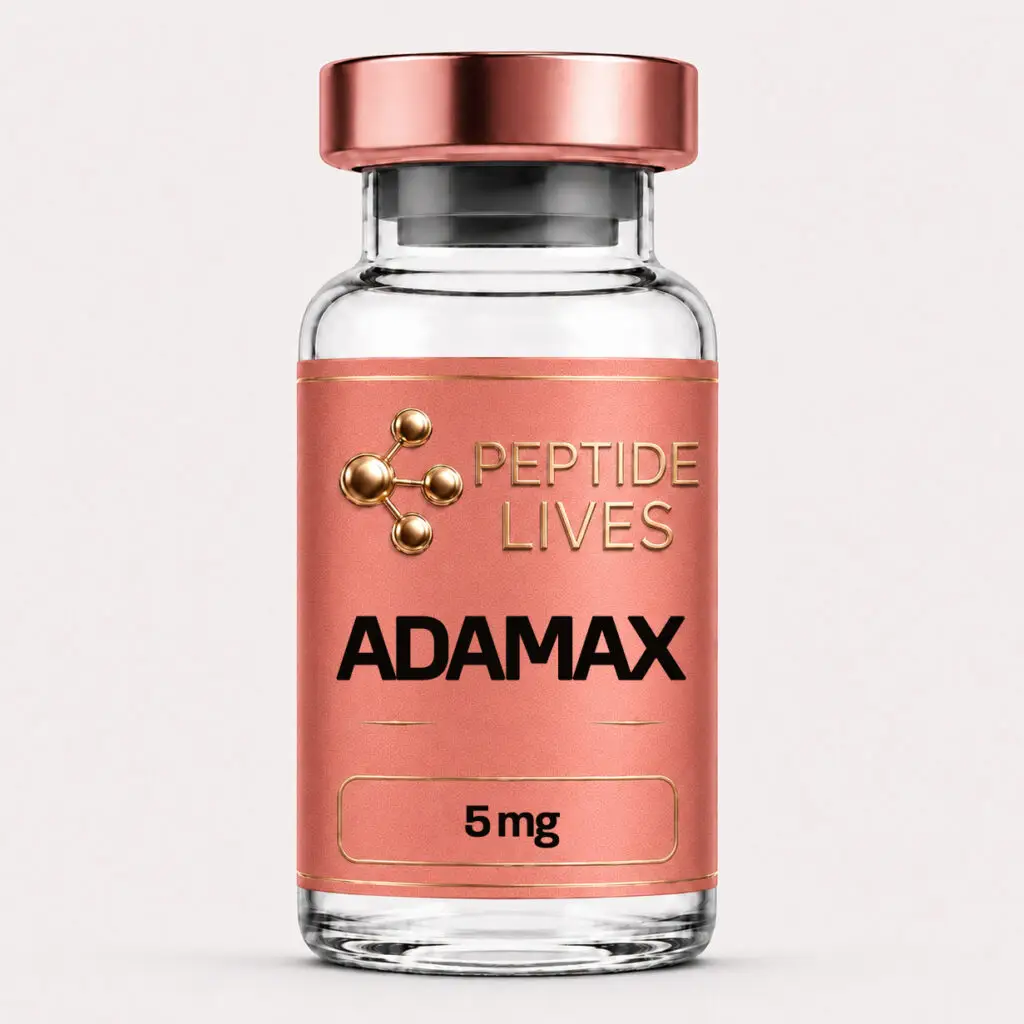
Description
Adamax Technical Overview
Adamax is a research compound commonly described by commercial peptide suppliers as a synthetic derivative of Semax.
Semax is a seven-amino-acid peptide derived from an adrenocorticotropic hormone fragment and extended with a Pro-Gly-Pro sequence.
Adamax is generally marketed as a structurally modified Semax analogue, with descriptions referring to N-terminal acetylation and adamantane-related modifications.
However, available commercial descriptions do not consistently identify the same molecular structure.
Some sources describe Adamax as an adamantane-modified Semax derivative, while others associate the name with different acetylated peptide structures.
As a result, a universally verified amino acid sequence, molecular formula, molecular weight, and CAS registry number cannot currently be established from independent reference databases.
Research involving the parent peptide Semax has investigated neurotrophin gene expression and cellular responses in experimental neurological models.
These findings do not demonstrate equivalent activity for Adamax.
Direct experimental characterization of Adamax remains limited, and its biological mechanisms have not been established through identifiable peer-reviewed studies. Simple Research Peptides
Compound Information
| Property | Value |
|---|---|
| Compound Name | Adamax |
| Alternative Names | Adamax Peptide |
| Reported Classification | Modified Semax Analogue |
| CAS Number | Not independently verified |
| PubChem CID | No verified compound record |
| Molecular Formula | Not independently established |
| Molecular Weight | Not independently established |
| Amino Acid Sequence | Requires manufacturer confirmation |
| Sequence Length | Not independently established |
| Peptide Structure | Reported modified peptide |
| Related Compound | Semax |
| Source | Reported as synthetic |
| Product Strength | 5mg |
| Research Category | Cognitive Research |
Chemical Identity Note: Adamax does not have a consistently established chemical identity across available commercial references. Molecular specifications should be obtained from the manufacturer’s structural documentation and verified against batch-specific analytical data before publication.
Storage and Handling
- Store Adamax according to the manufacturer’s verified stability documentation.
- Keep the research material protected from moisture and direct light.
- Minimize unnecessary temperature fluctuations during storage.
- Use appropriate laboratory procedures to prevent contamination.
- Avoid assuming that storage conditions established for Semax are necessarily suitable for Adamax.
Lyophilized Format
Adamax may be supplied as a lyophilized (freeze-dried) research material.
Lyophilization is a dehydration process commonly used in peptide preparation to reduce moisture content.
The stability of a lyophilized peptide depends on its chemical structure, formulation, packaging, and environmental conditions.
Because the precise chemical identity and stability characteristics of Adamax have not been independently established, storage recommendations should be based on manufacturer-provided stability data for the specific preparation.
Research Use Disclaimer
Adamax is described exclusively for laboratory research purposes.
This compound is not intended for human or veterinary consumption, clinical use, diagnostic applications, or therapeutic administration.
Adamax is not an FDA-approved drug or dietary supplement.
Its safety, biological activity, and potential pharmacological effects have not been adequately established through published clinical research.
ADAMAX RESEARCH
Adamax has attracted interest in the research peptide marketplace because of its reported structural relationship to Semax.
Semax is a synthetic peptide that has been investigated in experimental studies examining neurotrophin expression and neurological signaling.
The reported structural modifications of Adamax raise scientific questions about how changes to a peptide’s molecular structure may influence its physicochemical properties.
Relevant areas of investigation include peptide stability, chemical characterization, structural modification, and analytical identification.
However, research conducted on Semax cannot be treated as direct evidence of Adamax activity.
No independently verifiable, peer-reviewed experimental studies specifically characterizing Adamax were identified in the reviewed scientific literature.
Semax-Related Peptide Research
Semax is a synthetic heptapeptide with the amino acid sequence Met-Glu-His-Phe-Pro-Gly-Pro.
Experimental research has investigated its influence on neurotrophin gene expression in animal models.
A 2007 study examined changes in nerve growth factor (NGF) and brain-derived neurotrophic factor (BDNF) gene expression following Semax exposure in rats.
Researchers observed region-specific changes in neurotrophin expression.
These findings relate specifically to Semax and do not establish similar activity for Adamax. PubMed
Peptide Structural Modification Research
Chemical modifications are commonly investigated during peptide development to understand relationships between molecular structure and physicochemical behavior.
N-terminal acetylation is one modification that can influence peptide properties.
Adamantane-containing groups are also of interest in medicinal chemistry because of their distinctive molecular structure.
Commercial descriptions of Adamax refer to such modifications.
However, their presence, chemical positions, and effects must be confirmed for the specific compound.
No verified experimental evidence currently establishes that these modifications improve Adamax stability, biological activity, or cellular transport.
Neurotrophin Signaling Research
Neurotrophins are signaling proteins involved in neuronal development, survival, and cellular communication.
Semax has been investigated in experimental studies involving BDNF, NGF, and related signaling pathways.
A 2010 study examined Semax and Pro-Gly-Pro in rats subjected to experimental cerebral ischemia.
The researchers reported changes in transcription of neurotrophins and their receptor genes.
These observations provide scientific background for research on Semax-related peptide structures.
They do not demonstrate that Adamax produces equivalent effects. PubMed
Peptide Stability Research
Peptide stability is influenced by molecular structure, chemical modifications, environmental conditions, and formulation.
Chemical characterization is necessary to determine the stability of a specific peptide derivative.
For Adamax, reliable stability conclusions require confirmation of its precise molecular structure.
Published stability findings for Semax cannot automatically be extended to Adamax.
Analytical Characterization Research
Reliable identification of synthetic research peptides requires appropriate analytical methods.
High-performance liquid chromatography (HPLC) can provide information about chromatographic purity.
Mass spectrometry (MS) can support molecular mass determination and compound identification.
More detailed structural characterization may be necessary when different molecular structures are marketed under the same name.
For Adamax, analytical confirmation is particularly important because commercial descriptions of its structure are inconsistent.
Research Applications
| Research Area | Laboratory Research Focus |
|---|---|
| Peptide Chemistry | Structural characterization of modified peptides |
| Semax Analogue Research | Comparison of chemically defined peptide derivatives |
| Molecular Modification | Investigation of acetylation and other structural modifications |
| Analytical Chemistry | Compound identity and purity verification |
| Peptide Stability | Investigation of physicochemical stability |
| Structure–Activity Research | Relationships between molecular structure and activity |
| Neurotrophin Research | Background research involving the related peptide Semax |
FREQUENTLY ASKED QUESTIONS
What Is Adamax 5mg?
Adamax 5mg is a research product marketed as a modified Semax-related peptide.
Its exact chemical structure has not been consistently established across independent scientific databases.
What Is the Amino Acid Sequence of Adamax?
A universally verified amino acid sequence for Adamax has not been established.
Commercial sources report different structural descriptions.
The sequence of the specific material should be confirmed using manufacturer-provided structural documentation.
What Are the CAS Number and Molecular Weight of Adamax?
A verified CAS number and molecular weight could not be established for Adamax.
These specifications should not be assigned using data from Semax or other related peptides.
How Is Adamax Different From Semax?
Semax is a chemically characterized synthetic heptapeptide.
Adamax is marketed as a modified Semax-related compound, but its exact chemical identity requires confirmation.
Research findings involving Semax do not automatically apply to Adamax.
What Research Areas Involve Adamax?
Potential research areas include peptide chemistry, analytical characterization, molecular modification, stability investigation, and comparison with structurally related peptides.
Direct biological research on Adamax remains insufficient to establish specific pharmacological mechanisms.
Has Adamax Been Studied in Clinical Trials?
No registered clinical trials specifically investigating Adamax as a peptide were identified in the reviewed sources.
This does not establish that all possible research has been conducted or indexed.
Is Adamax Approved for Human Use?
No. Adamax is not FDA-approved for human therapeutic use.
The compound lacks established clinical safety and efficacy data.
SCIENTIFIC REFERENCES
1. Agapova T.Y. et al. (2007)
Neurotrophin Gene Expression in Rat Brain Under the Action of Semax, an Analogue of ACTH 4–10.
Neuroscience Letters, 417(2), 201–205.
This study examined Semax-associated changes in neurotrophin gene expression in rats.
https://pubmed.ncbi.nlm.nih.gov/17353092/
2. Dmitrieva V.G. et al. (2010)
Semax and Pro-Gly-Pro Activate the Transcription of Neurotrophins and Their Receptor Genes After Cerebral Ischemia.
Cellular and Molecular Neurobiology, 30, 71–79.
This study investigated Semax and Pro-Gly-Pro in experimental cerebral ischemia models.
https://pubmed.ncbi.nlm.nih.gov/19633950/
3. Related Semax Research
Comparison of the Temporary Dynamics of NGF and BDNF Gene Expression in Rat Hippocampus, Frontal Cortex, and Retina Under Semax Action.
This study examined region-specific changes in neurotrophin gene expression following Semax exposure.
https://pubmed.ncbi.nlm.nih.gov/19662538/
Research Evidence Note: All three publications concern Semax, not Adamax. They are provided as background references for the related parent peptide and must not be presented as evidence of Adamax’s biological activity.
CERTIFICATE OF ANALYSIS (COA)
A Certificate of Analysis provides analytical information about the identity, purity, and measured characteristics of a research compound.
For Adamax, chemical identity verification is particularly important because the compound’s molecular structure has not been consistently documented in independent scientific references.
Relevant analytical documentation should establish the molecular structure of the supplied material and confirm its identity using appropriate methods.
Depending on the analytical procedures performed, documentation may include HPLC and mass spectrometry results.
A purity percentage alone does not establish the molecular identity of an incompletely characterized compound.
For information about available Adamax analytical documentation, contact:
Peptide Lives
Website: https://peptidelives.com

Reviews
There are no reviews yet.