

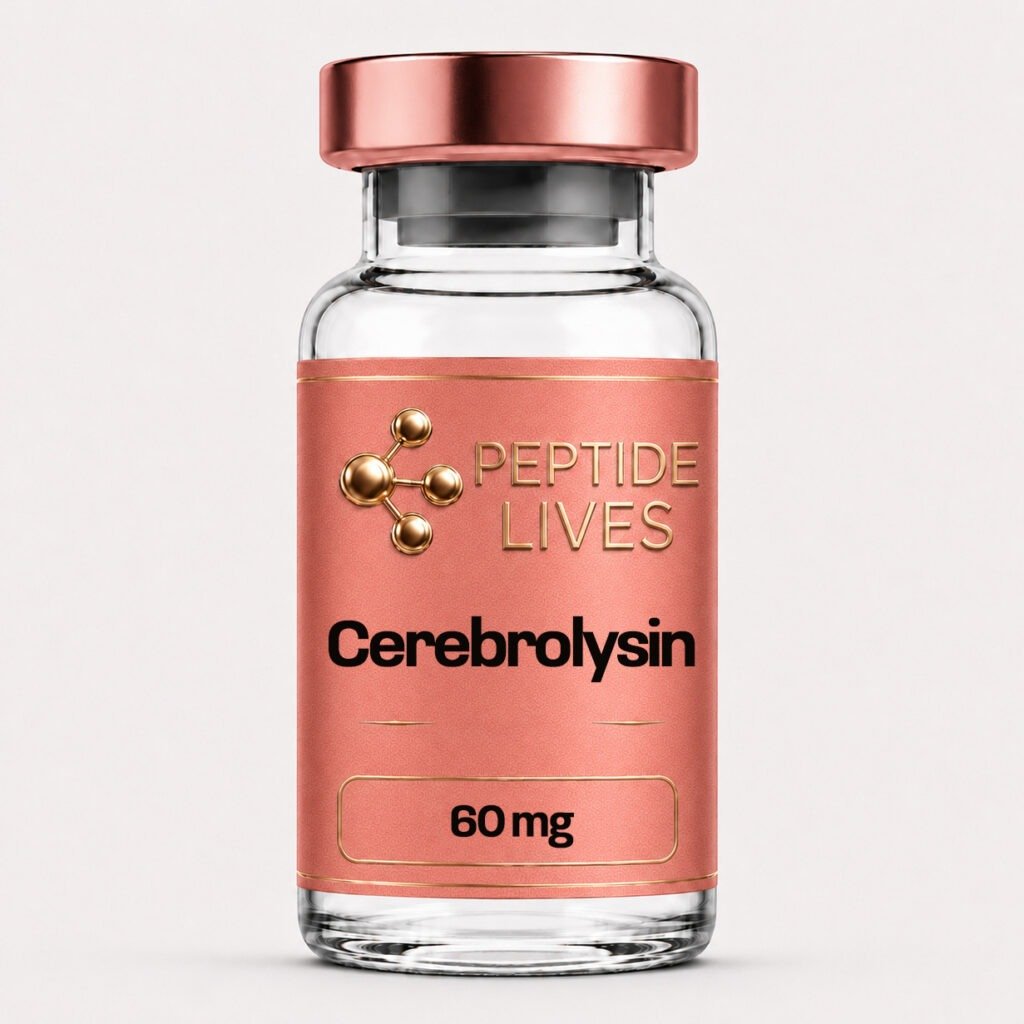
Description
Cerebrolysin Technical Overview
Cerebrolysin is a complex peptide-containing preparation derived from enzymatically processed porcine brain proteins. Unlike a single synthetic peptide, Cerebrolysin consists of multiple low-molecular-weight peptide fragments and free amino acids.
Cerebrolysin has been investigated in experimental neuroscience research involving neuronal survival, neurotrophic signaling, cellular stress responses, and neuroplasticity.
Published studies have evaluated standardized Cerebrolysin preparations in experimental models and clinical research involving neurological conditions. However, results obtained with a specific manufactured preparation cannot automatically be applied to a different peptide mixture marketed under the same name.
The precise composition, peptide distribution, and biological characteristics of the Peptide Lives 60mg preparation require manufacturer verification.
Compound Specifications
| Property | Value |
|---|---|
| Compound Name | Cerebrolysin |
| Classification | Peptide and amino acid mixture |
| Biological Source | Porcine brain protein hydrolysate |
| Composition | Multiple peptide fragments and free amino acids |
| Single CAS Number | Not applicable to a chemically heterogeneous mixture |
| Single Molecular Formula | Not applicable |
| Single Molecular Weight | Not applicable |
| Amino Acid Sequence | Multiple sequences; no single sequence |
| Listed Product Content | 60mg |
| Physical Form | Requires manufacturer confirmation |
| Research Category | Neuroscience Research |
The listed 60mg content requires confirmation of its meaning, including whether it refers to total peptide mass, total solids, or another manufacturing specification.
Storage and Handling
- Follow the manufacturer’s validated storage recommendations.
- Protect the material from contamination and unnecessary environmental exposure.
- Do not assume storage conditions for commercial liquid Cerebrolysin also apply to an experimental powder.
- Review batch-specific information for composition and stability.
Lyophilized Format
Cerebrolysin research materials may be supplied in different physical forms.
A lyophilized preparation should not be assumed equivalent to a standardized pharmaceutical Cerebrolysin solution. Differences in production, processing, and formulation may affect chemical composition and experimental activity.
Research Use Disclaimer
Cerebrolysin-containing research materials are not represented as FDA-approved pharmaceutical products. Cerebrolysin is not FDA-approved in the United States for neurological treatment.
This preparation is described exclusively for laboratory investigation and is not intended for human or veterinary administration.
Frequently Asked Questions
What Is Cerebrolysin 60mg?
Cerebrolysin 60mg is a product described as containing a peptide and amino acid preparation derived from porcine brain proteins. Its exact composition must be verified through manufacturer documentation.
Is Cerebrolysin a Single Peptide?
No. Cerebrolysin is a complex mixture rather than a single chemically defined peptide.
What Is the Molecular Weight of Cerebrolysin?
Cerebrolysin does not have a single molecular weight because it contains multiple molecular components.
What Research Areas Involve Cerebrolysin?
Research includes neuronal survival, neurotrophic signaling, cellular stress responses, and experimental models of neurological injury.
Is Research-Grade Cerebrolysin Equivalent to Pharmaceutical Cerebrolysin?
Not necessarily. Equivalence requires analytical and manufacturing evidence demonstrating comparable composition and quality.
Research Overview
Cerebrolysin has been studied in experimental neuroscience because its peptide-containing composition has been associated with various cellular responses in neuronal models.
Research has investigated effects on cellular survival, neuronal differentiation, neurotrophic signaling, and responses to ischemic injury.
Neurotrophic Signaling Research
Experimental investigations have examined signaling pathways associated with neuronal growth and survival following exposure to Cerebrolysin preparations.
Neuronal Stress Research
Cerebrolysin has been investigated in laboratory models involving oxidative stress, excitotoxicity, and experimentally induced neuronal injury.
Neuroplasticity Research
Research has examined neuronal remodeling and related biological processes in selected experimental systems.
Clinical Evidence Research
Clinical trials have investigated Cerebrolysin in neurological conditions, including ischemic stroke.
A Cochrane review published in 2023 did not establish a clear clinical benefit in acute ischemic stroke and identified important limitations in the evidence.
Clinical findings involving standardized preparations cannot establish the properties of an independently manufactured research product.
Research Applications
| Research Area | In Vitro Application |
|---|---|
| Neuronal Research | Cell survival and viability assays |
| Neurotrophic Signaling | Cellular signaling investigations |
| Cellular Stress | Experimental oxidative and metabolic stress models |
| Peptide Characterization | Analytical profiling of complex peptide mixtures |
References
- Muresanu D.F. et al. (2016). Cerebrolysin and Recovery After Stroke (CARS): A Randomized, Placebo-Controlled, Double-Blind, Multicenter Trial. Stroke. View publication.
- Ziganshina L.E. et al. (2023). Cerebrolysin for Acute Ischaemic Stroke. Cochrane Database of Systematic Reviews. View systematic review.
Certificate of Analysis (COA)
For a complex peptide mixture, analytical documentation should establish manufacturing origin, biological source, peptide distribution, total content, and relevant quality specifications.
Researchers should not treat a general purity percentage as sufficient evidence that a preparation is equivalent to standardized pharmaceutical Cerebrolysin.
For information about available documentation, contact Peptide Lives.


Reviews
There are no reviews yet.