

Description
KLOW Blend Technical Overview
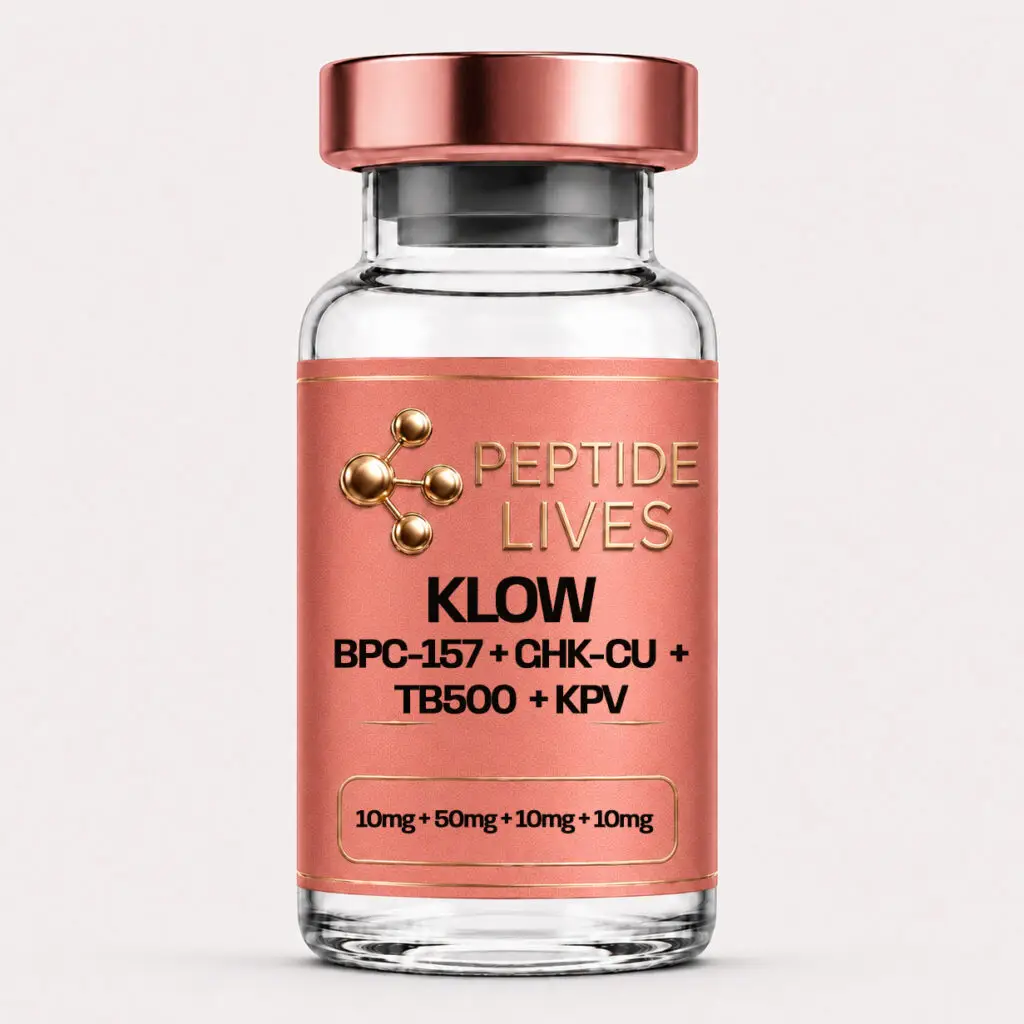
KLOW is a multi-peptide research formulation combining BPC-157, GHK-Cu, a TB-500-related peptide, and KPV.
The components belong to distinct molecular categories. BPC-157 is a synthetic 15-amino-acid peptide, GHK-Cu is a copper-associated tripeptide complex, KPV is a melanocortin-derived tripeptide, and TB-500 is a commercial designation for Thymosin Beta-4-related research materials.
Scientific research involving the individual compounds includes experimental cellular signaling, extracellular matrix biology, actin-associated processes, and immune-related pathways. The combination itself requires separate characterization.
Compound Specifications
| Property | Value |
|---|---|
| Product Name | KLOW Blend |
| Component 1 | BPC-157 |
| BPC-157 Sequence | GEPPPGKPADDAGLV |
| Component 2 | GHK-Cu |
| GHK Parent Sequence | GHK |
| Component 3 | TB-500-related peptide |
| TB-500 Structure | Product-specific |
| Component 4 | KPV |
| KPV Sequence | KPV |
| Individual Component Content | Not specified in product title |
| Total Vial Content | Not specified in product title |
| Classification | Four-component research peptide blend |
Storage and Handling
- Follow manufacturer-recommended stability conditions for the entire blend.
- Protect from moisture and contamination.
- Account for copper-associated interactions and formulation compatibility.
Lyophilized Format
KLOW may be manufactured as a lyophilized multi-peptide preparation. Stability depends on component chemistry and formulation.
Research Use Disclaimer
The KLOW blend is not an FDA-approved therapeutic product and is not intended for human or veterinary administration.
Frequently Asked Questions
What Does KLOW Contain?
BPC-157, GHK-Cu, TB-500-related peptide, and KPV.
Is KLOW a Single Peptide?
No. It is a four-component formulation.
What Is GHK-Cu?
A copper-associated Gly-His-Lys tripeptide complex.
Is TB-500 Always Full-Length Thymosin Beta-4?
No. Commercial naming can refer to different peptide structures.
Have All Four Components Been Clinically Validated Together?
No established clinical efficacy or safety has been demonstrated for this research combination.
KLOW Research Overview
The components of KLOW have been investigated separately in molecular and cellular research.
BPC-157 Research
Preclinical studies have examined responses in experimental tissue models.
GHK-Cu Research
Research investigates copper-peptide chemistry and extracellular matrix-associated pathways.
Thymosin Beta-4 Research
Full-length Tβ4 has been studied in actin binding and cellular migration.
KPV Research
Experimental work has examined inflammatory signaling and epithelial cellular responses.
Combination Research
Component compatibility, stability, and biological responses require direct investigation.
Research Applications
| Research Area | In Vitro Application |
|---|---|
| Extracellular Matrix | Fibroblast and matrix-associated assays |
| Cell Migration | Actin-related cellular research |
| Inflammatory Signaling | Epithelial and immune-cell assays |
| Analytical Chemistry | Multi-component identity and stability measurements |
References
- Pickart L, Margolina A. (2018). Regenerative and Protective Actions of the GHK-Cu Peptide in the Light of the New Gene Data. International Journal of Molecular Sciences. View publication.
- Goldstein AL, Hannappel E, Kleinman HK. (2005). Thymosin Beta4: Actin-Sequestering Protein Moonlights to Repair Injured Tissues. Trends in Molecular Medicine. View publication.
Certificate of Analysis (COA)
Analytical documentation should establish all four component identities, their individual concentrations, purity, and blend stability.

Reviews
There are no reviews yet.