

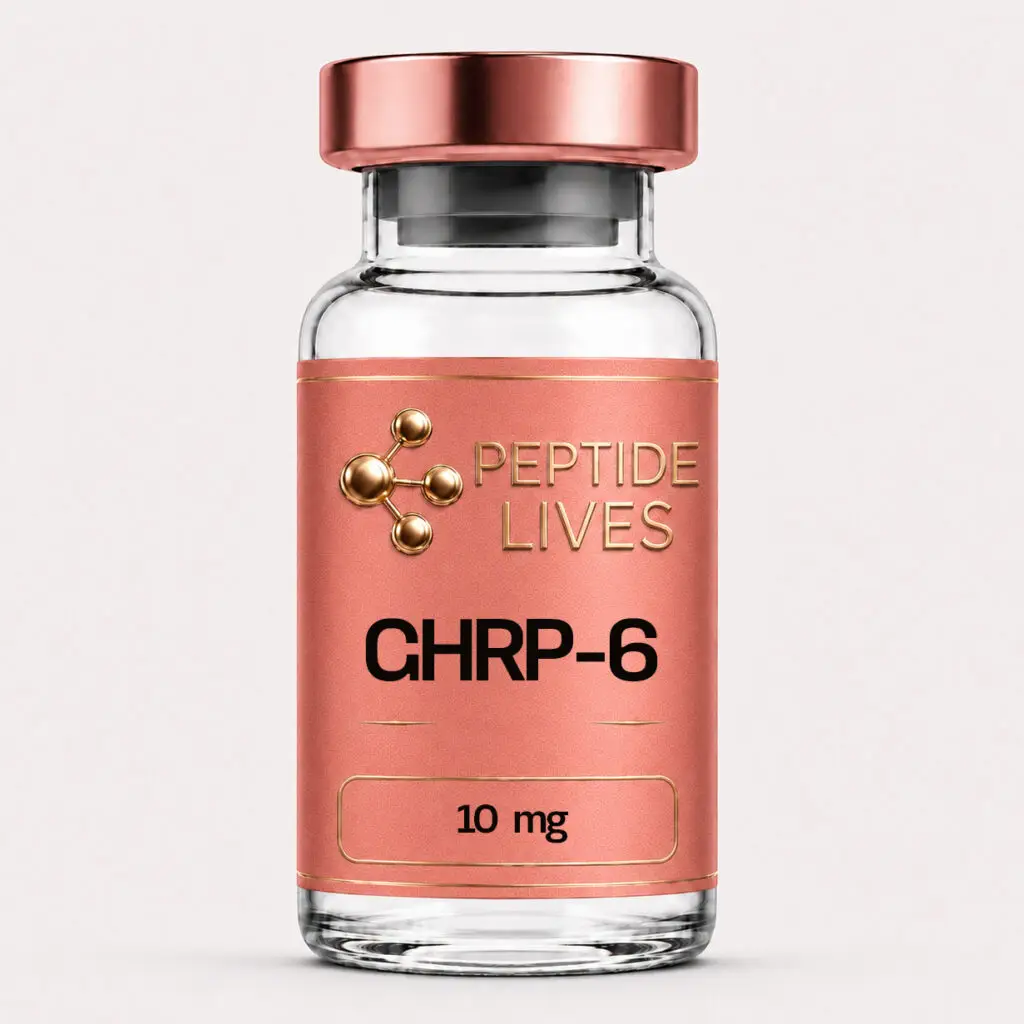
Description
GHRP-6 Technical Overview
GHRP-6 (Growth Hormone-Releasing Peptide-6), also known as Growth Hormone-Releasing Hexapeptide, is a synthetic peptide composed of six amino acid residues.
It belongs to the growth hormone secretagogue (GHS) family and has been investigated for its ability to activate the growth hormone secretagogue receptor (GHS-R1a).
GHRP-6 was originally developed as a synthetic growth hormone-releasing compound. Subsequent research established its interaction with the ghrelin receptor system, providing a foundation for studies of endocrine signaling and appetite regulation.
Unlike growth hormone-releasing hormone (GHRH), which interacts with the GHRH receptor, GHRP-6 activates the growth hormone secretagogue receptor. These distinct receptor pathways interact in the physiological regulation of growth hormone secretion.
The peptide contains two D-amino acid residues and a C-terminal amide group, structural features relevant to its biological activity.
Experimental studies have investigated GHRP-6 in models of growth hormone secretion, hypothalamic-pituitary signaling, ghrelin receptor activity, and feeding behavior.
Compound Specifications
| Property | Value |
|---|---|
| Compound Name | GHRP-6 |
| Full Name | Growth Hormone-Releasing Peptide-6 |
| Alternative Names | Growth Hormone-Releasing Hexapeptide, SKF-110679 |
| CAS Number | 87616-84-0 |
| PubChem CID | 9919153 |
| Molecular Formula | C₄₆H₅₆N₁₂O₆ |
| Molecular Weight | 873.0 g/mol |
| Monoisotopic Mass | 872.4446 Da |
| Amino Acid Sequence | His-D-Trp-Ala-Trp-D-Phe-Lys-NH₂ |
| Sequence Length | 6 amino acids |
| Peptide Structure | Linear, C-terminal amidated hexapeptide |
| Peptide Classification | Growth Hormone Secretagogue |
| Receptor Target | Growth Hormone Secretagogue Receptor (GHS-R1a) |
| Source | Synthetic |
| Vial Content | 10mg |
| Research Category | GH Research |
The molecular formula, molecular weight, and CAS number refer to the GHRP-6 free peptide. Salt forms, including acetate preparations, may have different composition-dependent molecular weights.
Chemical specifications are based on PubChem CID 9919153. PubChem
Storage and Handling
- Store GHRP-6 according to the manufacturer’s recommended temperature and stability conditions.
- Keep the research material tightly sealed and protected from moisture and direct light.
- Minimize unnecessary temperature fluctuations during laboratory storage.
- Avoid repeated freeze-thaw cycles when handling prepared research solutions.
- Follow established laboratory procedures to maintain compound integrity.
Lyophilized Format
GHRP-6 is commonly supplied for laboratory research in lyophilized (freeze-dried) form.
Lyophilization removes water from peptide preparations and can support stability during storage under appropriate conditions.
The stability of a lyophilized peptide depends on its chemical composition, formulation, packaging, and storage environment.
Researchers should consult batch-specific technical documentation for recommended storage and handling conditions.
Research Use Disclaimer
GHRP-6 is supplied exclusively for laboratory research purposes.
This compound is not intended for human or veterinary consumption, clinical use, diagnostic applications, or therapeutic administration.
GHRP-6 is not an FDA-approved drug or dietary supplement.
Peptide Lives supplies GHRP-6 solely for legitimate scientific research.
FREQUENTLY ASKED QUESTIONS
What Is GHRP-6 10mg?
GHRP-6 10mg is a synthetic six-amino-acid peptide classified as a growth hormone secretagogue.
It is studied for its interaction with the ghrelin receptor (GHS-R1a) and its involvement in growth hormone secretion, endocrine signaling, and appetite-related regulatory pathways.
What Is the Amino Acid Sequence of GHRP-6?
The amino acid sequence of GHRP-6 is:
His-D-Trp-Ala-Trp-D-Phe-Lys-NH₂
GHRP-6 contains six amino acid residues, including D-tryptophan and D-phenylalanine, and features a C-terminal amide group.
What Are the CAS Number and Molecular Weight of GHRP-6?
GHRP-6 has a CAS registry number of 87616-84-0 and a molecular weight of approximately 873.0 g/mol.
Its molecular formula is C₄₆H₅₆N₁₂O₆.
These specifications describe the free peptide rather than a particular salt formulation.
How Should GHRP-6 Be Stored?
GHRP-6 should be stored according to the manufacturer’s recommended stability and temperature conditions.
The material should remain protected from moisture, direct light, and unnecessary temperature fluctuations.
Researchers should follow the handling recommendations provided in the technical documentation for the specific batch.
What Research Areas Involve GHRP-6?
GHRP-6 has been studied in experimental research involving growth hormone secretion, ghrelin receptor signaling, hypothalamic-pituitary regulation, appetite-related pathways, and neuroendocrine communication.
What Is the Difference Between GHRP-6 and GHRP-2?
GHRP-6 and GHRP-2 are synthetic hexapeptides belonging to the growth hormone secretagogue family.
Both interact with the growth hormone secretagogue receptor, but they have different amino acid sequences and pharmacological characteristics.
Experimental studies have investigated their effects on growth hormone secretion and other endocrine responses.
Is GHRP-6 Approved for Human Use?
No. GHRP-6 is not FDA-approved for human therapeutic use.
Peptide Lives supplies this compound exclusively for laboratory research purposes.
RESEARCH OVERVIEW
GHRP-6 is one of the early synthetic growth hormone-releasing peptides developed for investigating endocrine signaling pathways.
Research conducted during the 1980s and 1990s demonstrated that GHRP-6 could stimulate growth hormone secretion through mechanisms distinct from those associated with growth hormone-releasing hormone.
The later identification of ghrelin and its receptor helped clarify the molecular pathways involved in growth hormone secretagogue activity.
GHRP-6 is now recognized as an agonist of the growth hormone secretagogue receptor (GHS-R1a).
Experimental investigations have examined its involvement in growth hormone secretion, hypothalamic-pituitary regulation, feeding behavior, and neuroendocrine responses.
These findings have contributed to scientific understanding of receptor-mediated endocrine communication.
Growth Hormone Secretagogue Receptor Research
GHRP-6 is investigated as a synthetic agonist of the growth hormone secretagogue receptor (GHS-R1a).
This G protein-coupled receptor is involved in endocrine signaling and is activated by the naturally occurring hormone ghrelin.
Experimental studies have characterized the interaction between GHRP-6 and the receptor system involved in growth hormone release.
Research involving synthetic secretagogues provides information about receptor activation, downstream signaling, and endocrine regulatory mechanisms.
Growth Hormone Signaling Research
Growth hormone secretion is regulated by interactions between hypothalamic hormones, pituitary cells, and endocrine feedback mechanisms.
GHRP-6 has been studied for its ability to stimulate growth hormone release through the growth hormone secretagogue receptor pathway.
Research has demonstrated that the growth hormone response to GHRP-6 is influenced by endogenous growth hormone-releasing hormone.
These findings highlight the functional relationship between distinct endocrine signaling pathways involved in growth hormone regulation.
Hypothalamic-Pituitary Research
The hypothalamic-pituitary axis coordinates several hormonal regulatory processes.
GHRP-6 has been investigated in studies examining interactions between hypothalamic signaling molecules and pituitary hormone secretion.
Experimental research has explored how growth hormone secretagogues interact with endogenous regulatory pathways.
These investigations contribute to understanding the mechanisms controlling pituitary responsiveness and endocrine communication.
Ghrelin Receptor Signaling Research
Ghrelin is an endogenous peptide hormone involved in growth hormone secretion and appetite-related signaling.
GHRP-6 activates the same receptor system and has been used in pharmacological research to investigate ghrelin-associated pathways.
Laboratory studies have examined receptor-mediated signaling and its relationship with endocrine and neural regulatory processes.
This research helps characterize the biological functions of the growth hormone secretagogue receptor.
Appetite Regulation Research
GHRP-6 has been investigated in experimental studies involving feeding behavior and appetite-related signaling.
Early animal research demonstrated that GHRP-6 could stimulate food intake through mechanisms not entirely dependent on growth hormone release.
A 2025 study in mice further investigated the effects of GHRP-6 on feeding behavior, hypothalamic neuronal activation, and growth hormone responses.
These findings support its relevance as a research compound for investigating ghrelin receptor signaling and the regulation of food intake. PubMed
Neuroendocrine Research
GHRP-6 is also studied in the broader context of neuroendocrine regulation.
The peptide provides a pharmacological model for investigating interactions between neural signaling, endocrine responses, and hormone secretion.
Experimental studies have examined growth hormone secretagogue activity in relation to hypothalamic signaling and pituitary hormone regulation.
These investigations contribute to the characterization of endocrine signaling networks.
Research Applications
| Research Area | Laboratory Research Focus |
|---|---|
| Growth Hormone Signaling | Investigation of growth hormone secretagogue pathways |
| GHS-R1a Receptor Research | Ghrelin receptor activation and signaling |
| Pituitary Hormone Research | Experimental analysis of growth hormone secretion |
| Hypothalamic Signaling | Hypothalamic-pituitary communication |
| Ghrelin Pathway Research | Receptor-mediated endocrine signaling |
| Appetite Regulation | Experimental investigation of feeding behavior |
| Endocrine Regulation | Hormonal signaling and feedback mechanisms |
| Neuroendocrine Research | Interactions between neural and endocrine pathways |
SCIENTIFIC REFERENCES
1. Growth Hormone (GH)-Releasing Peptide-6 Requires Endogenous Hypothalamic GH-Releasing Hormone for Maximal GH Stimulation (1998)
Journal of Clinical Endocrinology & Metabolism.
This study investigated the relationship between GHRP-6 and endogenous GHRH in growth hormone secretion.
https://pubmed.ncbi.nlm.nih.gov/9543138/
2. Intracerebroventricular Growth-Hormone-Releasing Peptide-6 Stimulates Eating Without Affecting Plasma Growth Hormone Responses in Rats (1995)
Life Sciences.
This experimental study examined GHRP-6-associated feeding behavior and growth hormone responses in rats.
https://pubmed.ncbi.nlm.nih.gov/8614257/
3. Intranasal Delivery of a Ghrelin Mimetic Engages the Brain Ghrelin Signaling System in Mice (2025)
Endocrinology.
This study investigated GHRP-6-mediated feeding responses, hypothalamic neuronal activation, and growth hormone signaling in mice.
https://pubmed.ncbi.nlm.nih.gov/39813130/
CERTIFICATE OF ANALYSIS (COA)
A Certificate of Analysis (COA) provides analytical information about a research compound, including its identity, purity, and other measured characteristics.
Available analytical documentation may include testing methods such as high-performance liquid chromatography (HPLC) and mass spectrometry (MS).
Researchers should review batch-specific documentation to verify compound identity and determine whether the research material meets their experimental requirements.
For information about available GHRP-6 analytical documentation, contact:
Peptide Lives
Website: https://peptidelives.com

Reviews
There are no reviews yet.