

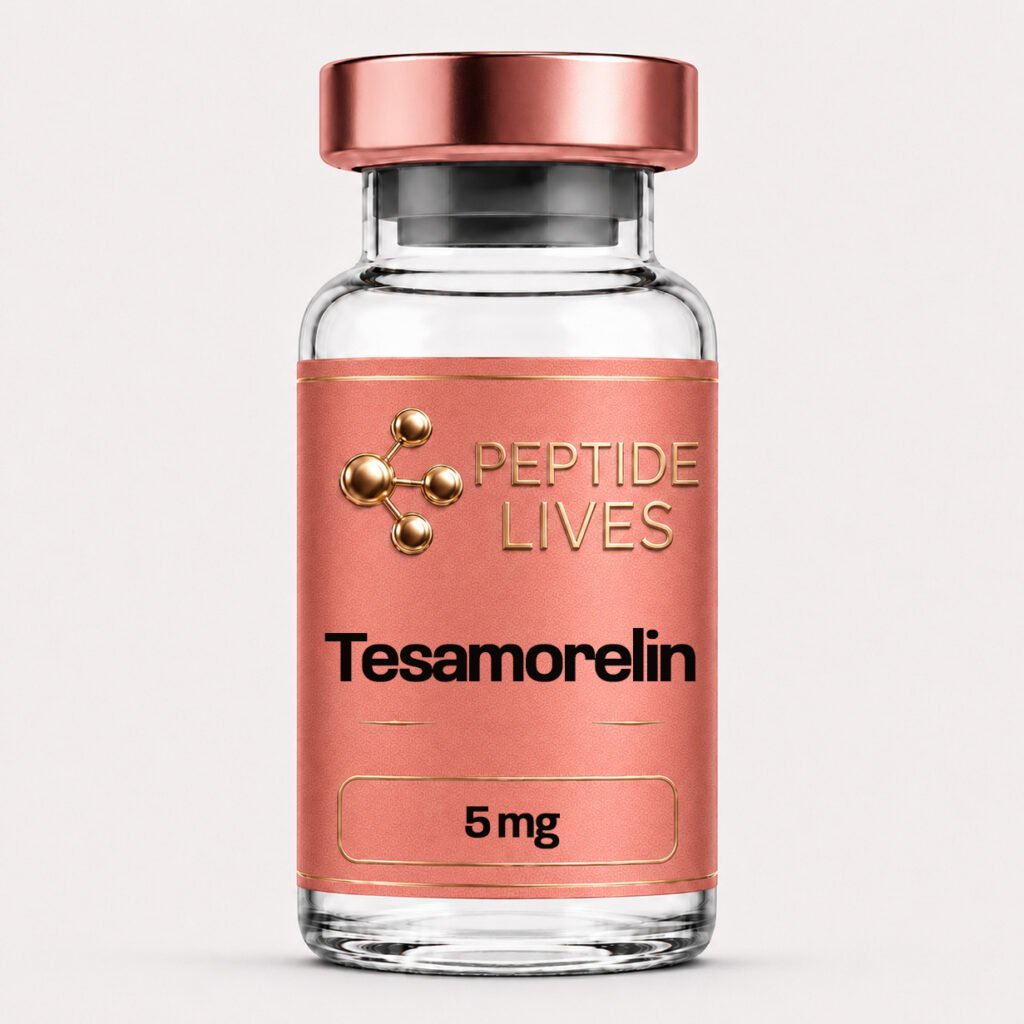
Description
Tesamorelin Technical Overview
Tesamorelin is a synthetic analogue of human growth hormone-releasing hormone (GHRH), containing the 44-residue human GHRH sequence with an N-terminal trans-3-hexenoyl modification.
It interacts with GHRH receptors on pituitary somatotroph cells and activates signaling associated with growth hormone release.
Tesamorelin has been investigated in clinical and experimental research involving pituitary function, growth hormone regulation, IGF-1 signaling, and body composition.
Compound Specifications
| Property | Value |
|---|---|
| Compound Name | Tesamorelin |
| Classification | Modified GHRH analogue |
| Peptide Length | 44 amino acids |
| Modification | N-terminal trans-3-hexenoyl group |
| Research Receptor | GHRHR |
| Vial Content | 5mg |
| Research Category | Endocrine Research |
Storage and Handling
- Follow the manufacturer’s validated stability conditions.
- Protect from moisture, excessive light, and contamination.
- Use appropriate peptide handling procedures.
Lyophilized Format
Tesamorelin may be manufactured in lyophilized form. Actual stability depends on the salt form and formulation.
Research Use Disclaimer
Specific prescription Tesamorelin products have FDA approval for defined indications. This research preparation is not represented as an approved medicine or suitable for human or veterinary administration.
Frequently Asked Questions
What Is Tesamorelin?
A modified 44-amino-acid GHRH analogue.
What Receptor Does It Activate?
GHRHR.
How Does Tesamorelin Differ From Sermorelin?
Tesamorelin is based on a modified 44-residue GHRH sequence; Sermorelin contains 29 residues.
What Research Areas Involve Tesamorelin?
Pituitary signaling, GH regulation, IGF-1 pathways, and endocrine biology.
Is This Research Preparation FDA-Approved?
No approval is claimed for this specific preparation.
Research Overview
Tesamorelin research focuses on GHRH receptor activation and related endocrine signaling.
GHRHR Signaling
Research examines receptor activation and cyclic AMP signaling.
Growth Hormone Research
Studies characterize pituitary growth hormone responses.
IGF-1 Regulation
Investigations examine downstream changes in IGF-1 signaling.
Research Applications
| Research Area | In Vitro Application |
|---|---|
| GHRHR | Receptor activation assays |
| Endocrine Signaling | cAMP pathway research |
| Peptide Chemistry | Modified GHRH characterization |
References
- Falutz J, Allas S, Blot K, et al. (2007). Metabolic Effects of a Growth Hormone-Releasing Factor in Patients With HIV. New England Journal of Medicine. Publication record.
Certificate of Analysis (COA)
Documentation should confirm the peptide identity, modification, purity, and vial content.

Reviews
There are no reviews yet.