

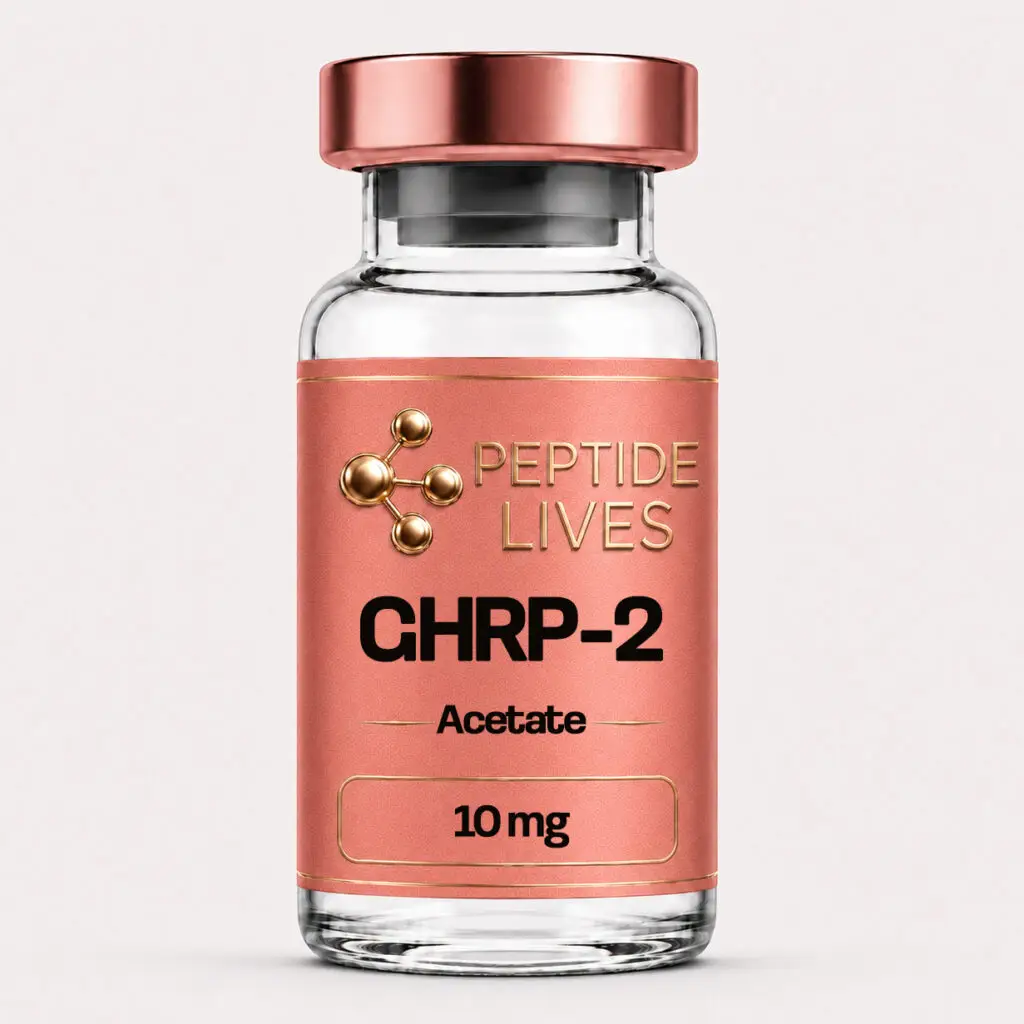
Description
GHRP-2 Acetate Technical Overview
GHRP-2 Acetate (Growth Hormone-Releasing Peptide-2), also known as Pralmorelin or KP-102, is a synthetic six-amino-acid peptide classified as a growth hormone secretagogue.
GHRP-2 was developed as a synthetic peptide capable of interacting with the growth hormone secretagogue receptor (GHS-R1a), the same receptor activated by the endogenous hormone ghrelin.
Unlike growth hormone-releasing hormone (GHRH), GHRP-2 interacts with the ghrelin receptor signaling system, making it an important research compound for investigating distinct pathways involved in growth hormone regulation.
Experimental studies have examined the peptide’s influence on pituitary hormone secretion, hypothalamic signaling, appetite-related pathways, and neuroendocrine responses.
GHRP-2 contains six amino acid residues, including modified D-amino acids and a nonstandard naphthylalanine residue. These structural characteristics distinguish it from naturally occurring peptide hormones.
The acetate form is used in synthetic peptide preparations for laboratory research.
Compound Specifications
| Property | Value |
|---|---|
| Compound Name | GHRP-2 Acetate |
| Alternative Names | Pralmorelin Acetate, KP-102 |
| Full Name | Growth Hormone-Releasing Peptide-2 Acetate |
| CAS Number | 158861-67-7 (GHRP-2 free peptide) |
| PubChem CID | 91971813 (Pralmorelin acetate) |
| Molecular Formula | C₄₇H₅₉N₉O₈ (monoacetate representation) |
| Molecular Weight | 878.0 g/mol (monoacetate representation) |
| Parent Peptide Molecular Weight | 818.0 g/mol |
| Amino Acid Sequence | H-D-Ala-D-2-Nal-Ala-Trp-D-Phe-Lys-NH₂ |
| Sequence Length | 6 amino acids |
| Peptide Structure | Linear, C-terminal amidated peptide |
| Peptide Classification | Growth Hormone Secretagogue |
| Receptor Target | Growth Hormone Secretagogue Receptor (GHS-R1a) |
| Source | Synthetic |
| Vial Content | 10mg |
| Research Category | Endocrine Research |
Note: The molecular formula and molecular weight shown for the acetate form represent a 1:1 peptide-to-acetic-acid composition. Actual acetate content and peptide-equivalent mass are batch-dependent and should be verified using analytical documentation.
Chemical identity data are based on PubChem records for Pralmorelin and Pralmorelin Acetate.
Storage and Handling
- Store GHRP-2 Acetate according to the manufacturer’s recommended temperature and stability conditions.
- Keep the container tightly sealed and protected from moisture and direct sunlight.
- Minimize exposure to unnecessary temperature fluctuations during laboratory handling.
- Avoid repeated freeze-thaw cycles when working with prepared research solutions.
- Follow established laboratory procedures to preserve peptide integrity and prevent contamination.
Lyophilized Format
GHRP-2 Acetate is commonly supplied for laboratory research in lyophilized (freeze-dried) form.
Lyophilization is a dehydration process used in peptide preparation to reduce moisture content and support compound stability during storage.
The stability of lyophilized research peptides depends on their chemical structure, formulation, packaging, and environmental conditions.
Researchers should consult the manufacturer’s documentation for batch-specific storage recommendations and handling requirements.
Research Use Disclaimer
GHRP-2 Acetate is supplied exclusively for laboratory research purposes.
This compound is not intended for human or veterinary consumption, clinical use, diagnostic applications, or therapeutic administration.
It is not an FDA-approved drug or dietary supplement.
Peptide Lives supplies GHRP-2 Acetate solely for legitimate scientific research.
FREQUENTLY ASKED QUESTIONS
What Is GHRP-2 Acetate 10mg?
GHRP-2 Acetate 10mg is a synthetic hexapeptide studied for its interaction with the growth hormone secretagogue receptor (GHS-R1a).
Also known as Pralmorelin, it is investigated in experimental research involving growth hormone signaling, ghrelin receptor activity, and hypothalamic-pituitary regulation.
What Is the Amino Acid Sequence of GHRP-2?
The amino acid sequence of GHRP-2 is:
H-D-Ala-D-2-Nal-Ala-Trp-D-Phe-Lys-NH₂
The peptide consists of six amino acid residues and features a C-terminal amide group.
Its structure includes D-amino acids and a modified naphthylalanine residue.
What Are the CAS Number and Molecular Weight of GHRP-2 Acetate?
The parent GHRP-2 peptide has CAS number 158861-67-7 and a molecular weight of approximately 818.0 g/mol.
PubChem lists a monoacetate representation of Pralmorelin Acetate with a molecular weight of approximately 878.0 g/mol.
The exact acetate composition of an individual preparation should be confirmed using batch-specific documentation.
How Should GHRP-2 Acetate Be Stored?
GHRP-2 Acetate should be stored according to the manufacturer’s recommended temperature and stability conditions.
The compound should remain protected from moisture, direct light, and excessive temperature fluctuations.
Researchers should refer to available technical documentation for specific storage requirements.
What Research Areas Involve GHRP-2 Acetate?
GHRP-2 Acetate has been investigated in research involving growth hormone secretion, ghrelin receptor signaling, hypothalamic-pituitary communication, appetite regulation, and endocrine responses.
What Is the Difference Between GHRP-2 and GHRH?
GHRP-2 and growth hormone-releasing hormone (GHRH) interact with different receptor systems.
GHRP-2 acts through the growth hormone secretagogue receptor, while GHRH acts through the GHRH receptor.
Research has investigated how these distinct signaling pathways interact in regulating growth hormone secretion.
Is GHRP-2 Acetate Approved for Human Use?
GHRP-2 Acetate is not FDA-approved for human therapeutic use.
Peptide Lives supplies this compound exclusively for laboratory research purposes.
RESEARCH OVERVIEW
GHRP-2 is a synthetic growth hormone secretagogue that has been extensively investigated in experimental endocrine research.
Early studies examined the peptide’s ability to stimulate growth hormone secretion through mechanisms distinct from those associated with naturally occurring growth hormone-releasing hormone.
Following the identification of ghrelin and its receptor, GHRP-2 became an important research compound for investigating the growth hormone secretagogue receptor signaling system.
Experimental investigations have explored GHRP-2 activity in pituitary hormone secretion, appetite-related signaling, and hypothalamic-pituitary regulation.
These studies have contributed to the understanding of receptor-mediated endocrine communication and the physiological roles of ghrelin-associated signaling pathways.
Growth Hormone Secretagogue Receptor Research
GHRP-2 is investigated as a synthetic agonist of the growth hormone secretagogue receptor (GHS-R1a).
This receptor is involved in endocrine signaling pathways associated with growth hormone regulation and metabolic communication.
Laboratory and clinical pharmacology studies have examined receptor activation and subsequent hormonal responses following exposure to GHRP-2.
These investigations help researchers characterize the signaling mechanisms associated with synthetic ghrelin receptor agonists.
Growth Hormone Signaling Research
Growth hormone secretion is regulated through complex interactions between hypothalamic signaling molecules, pituitary cells, and peripheral endocrine feedback mechanisms.
GHRP-2 has been investigated for its ability to stimulate growth hormone secretion through the growth hormone secretagogue receptor pathway.
Experimental studies have compared GHRP-2-mediated signaling with the activity of growth hormone-releasing hormone.
These investigations have demonstrated that GHRP-2 and GHRH interact with distinct receptor systems and may produce complementary signaling responses.
Hypothalamic-Pituitary Research
The hypothalamic-pituitary axis plays a central role in endocrine regulation.
GHRP-2 has been studied in experimental models investigating pituitary hormone secretion and interactions between hypothalamic regulatory pathways.
Research has examined the peptide’s influence on growth hormone, prolactin, adrenocorticotropic hormone (ACTH), and cortisol responses.
These findings contribute to the understanding of receptor-mediated hormonal signaling and interactions between endocrine pathways.
Ghrelin Receptor Signaling Research
Ghrelin is an endogenous peptide hormone that interacts with the growth hormone secretagogue receptor.
GHRP-2 acts as a synthetic agonist of this receptor and is used in research investigating ghrelin-associated signaling mechanisms.
Experimental studies have explored receptor activation, endocrine responses, and the relationship between ghrelin receptor signaling and physiological regulatory processes.
This research provides insight into the molecular mechanisms involved in hormone secretion and metabolic communication.
Appetite Regulation Research
GHRP-2 has also been investigated in experimental research involving appetite and food-intake regulation.
Studies have examined the relationship between ghrelin receptor activation and hypothalamic pathways associated with hunger signaling.
In controlled human pharmacology studies, GHRP-2 exposure was associated with increased food intake, providing evidence of its activity within appetite-related regulatory systems.
These findings support continued investigation into the relationship between ghrelin receptor signaling and energy balance.
Neuroendocrine Research
GHRP-2 is studied as part of broader research into neuroendocrine regulation.
Researchers have examined how synthetic growth hormone secretagogues interact with signaling pathways connecting the nervous and endocrine systems.
Experimental investigations include pituitary responsiveness, hormone secretion patterns, and receptor-mediated regulatory mechanisms.
These studies contribute to scientific understanding of endocrine signaling networks.
Research Applications
| Research Area | Laboratory Research Focus |
|---|---|
| Growth Hormone Signaling | Investigation of growth hormone secretagogue pathways |
| GHS-R1a Receptor Research | Ghrelin receptor activation and signaling |
| Pituitary Hormone Research | Experimental analysis of pituitary endocrine responses |
| Hypothalamic Signaling | Investigation of hypothalamic-pituitary communication |
| Ghrelin Pathway Research | Receptor-mediated endocrine signaling mechanisms |
| Appetite Regulation | Experimental investigation of food-intake signaling |
| Endocrine Regulation | Hormonal response pathways and feedback mechanisms |
| Neuroendocrine Research | Interactions between neural and endocrine signaling |
SCIENTIFIC REFERENCES
1. Arvat E. et al. (1997)
Effects of GHRP-2 and Hexarelin, Two Synthetic GH-Releasing Peptides, on GH, Prolactin, ACTH and Cortisol Levels in Man. Comparison with the Effects of GHRH, TRH and hCRH.
Peptides, 18(6), 885–891.
https://pubmed.ncbi.nlm.nih.gov/9285939/
2. Growth Hormone-Releasing Peptide-2 Stimulates GH Secretion in GH-Deficient Patients with Mutated GH-Releasing Hormone Receptor (2001)
Journal of Clinical Endocrinology & Metabolism.
https://pubmed.ncbi.nlm.nih.gov/11443201/
3. Growth Hormone Releasing Peptide-2 (GHRP-2), Like Ghrelin, Increases Food Intake in Healthy Men (2005)
Journal of Clinical Endocrinology & Metabolism.
https://pubmed.ncbi.nlm.nih.gov/15699539/
4. Obese Subjects Respond to the Stimulatory Effect of the Ghrelin Agonist Growth Hormone-Releasing Peptide-2 on Food Intake (2006)
Obesity.
https://pubmed.ncbi.nlm.nih.gov/16861611/
5. Growth Hormone-Releasing Peptide-2 (GHRP-2) Does Not Act via the Human Growth Hormone-Releasing Factor Receptor in GC Cells (1998)
https://pubmed.ncbi.nlm.nih.gov/9798733/
CERTIFICATE OF ANALYSIS (COA)
A Certificate of Analysis (COA) provides analytical information about a research compound, including its identity, purity, and other measured characteristics.
Available testing documentation may include analytical methods such as high-performance liquid chromatography (HPLC) and mass spectrometry (MS).
Researchers should review batch-specific documentation to verify compound identity and assess whether the material meets their experimental requirements.
For information about available GHRP-2 Acetate analytical documentation, contact:
Peptide Lives
Email: info@peptidelives.com
Website: https://peptidelives.com

Reviews
There are no reviews yet.