

Description
ARA-290 Technical Overview
ARA-290, also known as Cibinetide, PHBSP, or Pyroglutamate Helix B Surface Peptide, is a synthetic 11-amino-acid peptide developed from a structural region of erythropoietin (EPO).
Erythropoietin is a naturally occurring glycoprotein hormone best known for its role in red blood cell production. However, scientific investigations have also identified EPO-associated signaling pathways involved in cellular responses to injury and inflammation.
ARA-290 was designed to investigate tissue-protective signaling while avoiding the erythropoietic activity associated with conventional EPO receptor activation.
The peptide is studied for its interaction with the innate repair receptor (IRR), commonly described in the literature as a receptor complex involving the erythropoietin receptor (EPOR) and beta-common receptor (CD131).
This proposed receptor mechanism has been investigated in experimental studies of inflammation, tissue injury, and cellular stress responses.
ARA-290 contains 11 amino acid residues and features an N-terminal pyroglutamate modification. This structural characteristic distinguishes it from an unmodified linear peptide sequence.
Published research has examined ARA-290 in experimental and clinical investigations involving peripheral nerve function, inflammatory signaling, tissue-protective responses, and cellular repair processes.
The precise receptor mechanisms remain an area of scientific investigation. PubMed
Compound Information
| Property | Value |
|---|---|
| Compound Name | ARA-290 |
| Alternative Names | Cibinetide, PHBSP, ARA290 |
| Full Name | Pyroglutamate Helix B Surface Peptide |
| CAS Number | 1208243-50-8 |
| PubChem CID | 91810664 |
| Molecular Formula | C₅₁H₈₄N₁₆O₂₁ |
| Molecular Weight | 1257.3 g/mol |
| Amino Acid Sequence | pGlu-Glu-Gln-Leu-Glu-Arg-Ala-Leu-Asn-Ser-Ser |
| Sequence Length | 11 amino acid residues |
| Peptide Structure | Linear peptide with N-terminal pyroglutamate |
| Peptide Classification | Erythropoietin-Derived Peptide |
| Research Target | Innate Repair Receptor (IRR) signaling |
| Source | Synthetic |
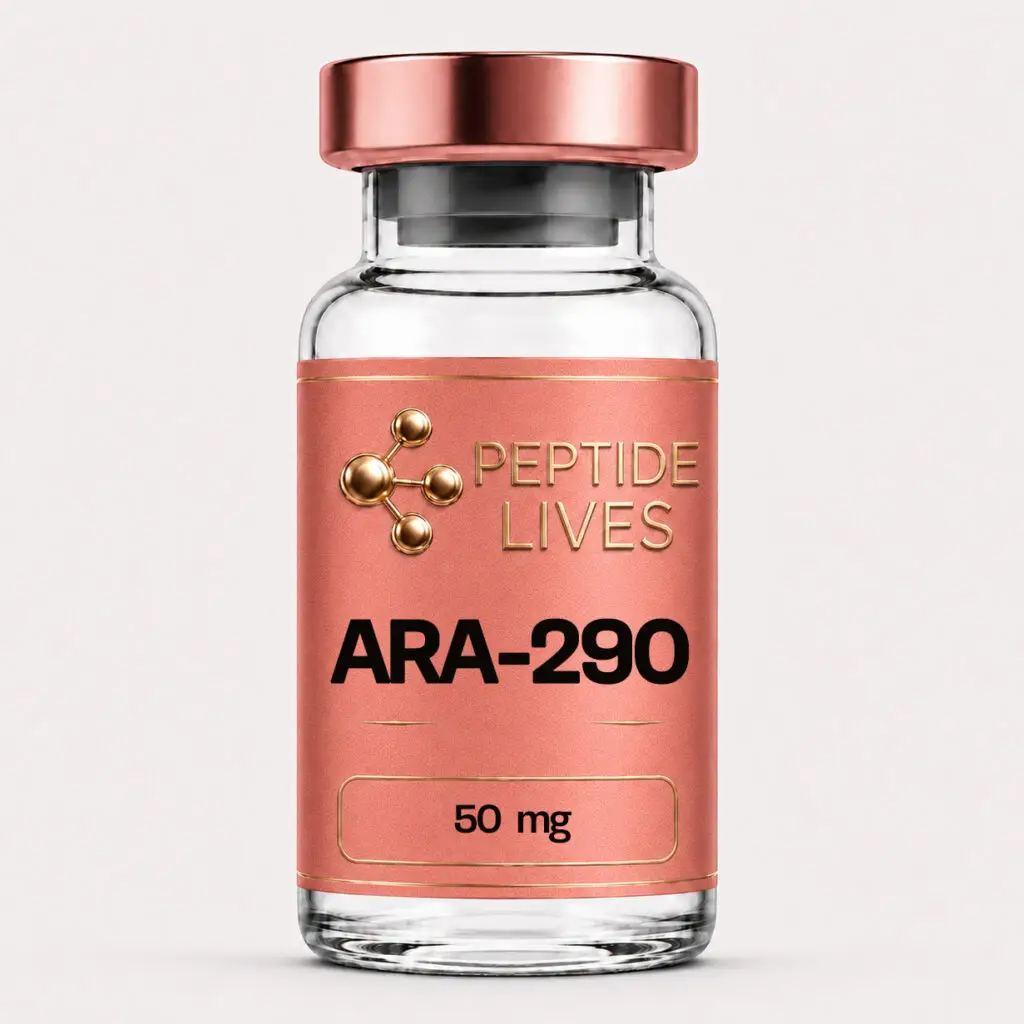
| Vial Content | 50mg |
| Research Category | Tissue Repair Research |
Chemical data: PubChem — Cibinetide (CID 91810664).
The listed molecular formula and molecular weight refer to the parent Cibinetide compound. The composition of a particular salt or formulated preparation may differ.
The N-terminal pyroglutamate residue is essential to the specified chemical identity and should not be represented as ordinary glutamine. PubChem
Storage and Handling
- Store ARA-290 according to the manufacturer’s recommended temperature and stability conditions.
- Keep the container tightly sealed and protected from moisture and direct light.
- Minimize unnecessary temperature fluctuations during laboratory storage.
- Avoid repeated freeze-thaw cycles when handling prepared research solutions.
- Follow established laboratory procedures to maintain compound integrity and minimize contamination.
Lyophilized Format
ARA-290 is commonly supplied for laboratory research in lyophilized (freeze-dried) form.
Lyophilization removes water from peptide preparations and can help maintain compound stability during storage under appropriate conditions.
The stability of lyophilized ARA-290 depends on its formulation, packaging, moisture exposure, and storage environment.
Researchers should refer to batch-specific technical documentation to determine appropriate storage conditions.
Research Use Disclaimer
ARA-290 is supplied exclusively for laboratory research purposes.
This compound is not intended for human or veterinary consumption, clinical use, diagnostic applications, or therapeutic administration.
ARA-290 is not an FDA-approved drug or dietary supplement.
Peptide Lives supplies ARA-290 solely for legitimate scientific research.
ARA-290 RESEARCH
ARA-290 was developed as a synthetic peptide designed to reproduce selected tissue-protective signaling properties associated with erythropoietin without reproducing its principal red blood cell-stimulating activity.
Research into erythropoietin signaling identified potential differences between pathways regulating erythropoiesis and those associated with cellular responses to injury.
These observations contributed to the development of short peptide derivatives, including ARA-290, for investigating tissue-protective signaling mechanisms.
Experimental studies have examined ARA-290 in models of inflammatory injury, peripheral nerve dysfunction, and tissue stress.
Small clinical studies have also investigated Cibinetide in individuals with sarcoidosis-associated small fiber neuropathy.
These investigations have produced preliminary findings involving neuropathic symptom scores, peripheral nerve measurements, and inflammatory signaling.
However, these results do not establish ARA-290 as an approved or proven treatment for neuropathy or other medical conditions. PubMed
Innate Repair Receptor Research
ARA-290 is studied for its interaction with the innate repair receptor, a signaling system associated with cellular responses to injury and inflammation.
The receptor has been described in research literature as involving the erythropoietin receptor and the beta-common receptor (CD131).
Experimental investigations have examined the relationship between this proposed receptor complex and downstream signaling involved in cellular survival and inflammatory regulation.
The exact composition and signaling mechanisms of the tissue-protective receptor remain subjects of scientific investigation.
Tissue-Protective Signaling Research
ARA-290 has been investigated in experimental models examining cellular responses to tissue damage.
Research has focused on pathways associated with cellular stress, inflammatory signaling, and tissue-protective responses.
These investigations aim to characterize how erythropoietin-derived peptides interact with signaling systems involved in tissue injury.
The findings are primarily mechanistic and experimental and should not be interpreted as evidence of established therapeutic efficacy.
Peripheral Nerve Research
One of the most extensively investigated areas of ARA-290 research involves peripheral nerve function.
Clinical studies have examined Cibinetide in individuals experiencing small fiber neuropathy associated with sarcoidosis.
A randomized, double-blind pilot study published in 2012 evaluated ARA-290 in 22 participants.
The investigators reported improvements in certain neuropathy-related symptom measurements compared with placebo.
Other outcomes did not demonstrate significant differences between treatment groups.
These findings supported further investigation but did not establish definitive clinical effectiveness. PubMed
Small Fiber Neuropathy Research
Small fiber neuropathy involves damage or dysfunction of small peripheral nerve fibers responsible for sensory and autonomic functions.
ARA-290 has been investigated in studies assessing neuropathic symptoms and structural measurements of peripheral nerve fibers.
A 2013 randomized clinical investigation examined changes in neuropathy-related symptoms and corneal small nerve fiber density.
The researchers reported improvements in selected symptom measurements and increases in corneal nerve fiber density.
A subsequent phase 2b trial further investigated corneal nerve fiber measurements and other clinical outcomes.
These studies provide preliminary evidence supporting scientific interest in ARA-290-associated nerve signaling and repair processes, although larger confirmatory studies are necessary. PubMed
Inflammatory Signaling Research
ARA-290 has been investigated in experimental research involving inflammatory pathways.
Scientific studies have examined whether activation of tissue-protective signaling systems influences cellular responses associated with inflammation.
These investigations include research into the interaction between erythropoietin-derived peptides, inflammatory signaling molecules, and cellular stress pathways.
Results from experimental models contribute to understanding potential relationships between innate repair signaling and inflammatory regulation.
Cellular Repair Research
ARA-290 is studied in research examining cellular recovery following injury and metabolic stress.
Experimental investigations have focused on cellular survival pathways and the regulation of tissue responses to damage.
Research involving erythropoietin-derived peptides has explored how tissue-protective signaling may differ from pathways responsible for red blood cell production.
These investigations contribute to the broader scientific understanding of cellular repair mechanisms and receptor-mediated stress responses.
Research Applications
| Research Area | Laboratory Research Focus |
|---|---|
| Innate Repair Receptor Research | Investigation of tissue-protective receptor signaling |
| Erythropoietin Signaling | Non-erythropoietic signaling pathways |
| Peripheral Nerve Research | Experimental analysis of peripheral nerve function |
| Small Fiber Neuropathy Research | Nerve fiber measurements and neuropathy-related mechanisms |
| Inflammatory Signaling | Cellular inflammatory response pathways |
| Tissue Injury Research | Cellular responses to experimental tissue damage |
| Cellular Repair Research | Investigation of tissue-protective signaling mechanisms |
| Neuroprotective Research | Experimental cellular responses to neuronal stress |
FREQUENTLY ASKED QUESTIONS
What Is ARA-290 50mg?
ARA-290 50mg is a synthetic 11-amino-acid research peptide derived from a tissue-protective region of erythropoietin.
Also known as Cibinetide, it is investigated in research involving innate repair receptor signaling, inflammatory pathways, and peripheral nerve function.
What Is the Amino Acid Sequence of ARA-290?
The amino acid sequence is:
pGlu-Glu-Gln-Leu-Glu-Arg-Ala-Leu-Asn-Ser-Ser
ARA-290 consists of 11 amino acid residues and contains an N-terminal pyroglutamate modification.
What Are the CAS Number and Molecular Weight of ARA-290?
ARA-290 has CAS number 1208243-50-8 and a molecular weight of approximately 1257.3 g/mol.
Its molecular formula is C₅₁H₈₄N₁₆O₂₁.
These specifications describe the parent Cibinetide compound.
How Should ARA-290 Be Stored?
ARA-290 should be stored according to the manufacturer’s recommended stability and temperature conditions.
The research material should remain protected from moisture, direct light, and unnecessary temperature fluctuations.
Specific storage requirements should be confirmed using technical documentation for the individual preparation.
What Research Areas Involve ARA-290?
ARA-290 has been investigated in experimental research involving innate repair receptor signaling, tissue-protective pathways, inflammation, peripheral nerve function, and cellular responses to injury.
What Is the Difference Between ARA-290 and Erythropoietin?
Erythropoietin is a naturally occurring glycoprotein hormone involved in the regulation of red blood cell production.
ARA-290 is a synthetic 11-amino-acid peptide developed from a tissue-protective region of erythropoietin.
Unlike conventional erythropoietin, ARA-290 was designed to investigate tissue-protective signaling without stimulating red blood cell production.
Is ARA-290 Approved for Human Use?
No. ARA-290, also known as Cibinetide, is not FDA-approved for human therapeutic use.
Peptide Lives supplies ARA-290 exclusively for laboratory research purposes.
SCIENTIFIC REFERENCES
1. Brines M. et al. (2008)
Nonerythropoietic, Tissue-Protective Peptides Derived from the Tertiary Structure of Erythropoietin.
Proceedings of the National Academy of Sciences, 105(31), 10925–10930.
This study investigated the development and experimental tissue-protective activity of short erythropoietin-derived peptides.
https://pubmed.ncbi.nlm.nih.gov/18676614/
2. Heij L. et al. (2012)
Safety and Efficacy of ARA 290 in Sarcoidosis Patients with Symptoms of Small Fiber Neuropathy: A Randomized, Double-Blind Pilot Study.
Molecular Medicine, 18, 1430–1436.
This preliminary clinical trial investigated ARA-290-associated changes in neuropathy symptoms and other clinical outcomes.
https://pubmed.ncbi.nlm.nih.gov/23168581/
3. Dahan A. et al. (2013)
ARA 290 Improves Symptoms in Patients with Sarcoidosis-Associated Small Nerve Fiber Loss and Increases Corneal Nerve Fiber Density.
Molecular Medicine, 19, 334–345.
This randomized investigation examined neuropathic symptoms and corneal nerve fiber measurements.
https://pubmed.ncbi.nlm.nih.gov/24136731/
4. Brines M. et al. (2015)
ARA 290, a Nonerythropoietic Peptide Engineered from Erythropoietin, Improves Metabolic Control and Neuropathic Symptoms in Patients with Type 2 Diabetes.
Molecular Medicine, 20, 658–666.
This phase 2 study examined ARA-290-associated metabolic and neuropathy-related outcomes in participants with type 2 diabetes.
https://pubmed.ncbi.nlm.nih.gov/25387363/
5. Brines M. (2015)
Flipping the Molecular Switch for Innate Protection and Repair of Tissues: Long-Lasting Effects of a Non-Erythropoietic Small Peptide Engineered from Erythropoietin.
Pharmacology & Therapeutics.
This review examines the proposed innate repair receptor mechanism and experimental findings involving ARA-290.
https://pubmed.ncbi.nlm.nih.gov/25728128/
6. Brines M. et al. (2018)
Targeting the Innate Repair Receptor to Treat Neuropathy.
Pain Reports.
This review discusses preclinical and clinical investigations of ARA-290 in peripheral neuropathy research.
https://pubmed.ncbi.nlm.nih.gov/29392190/
CERTIFICATE OF ANALYSIS (COA)
A Certificate of Analysis (COA) provides analytical information about a research compound, including its identity, purity, and other measured characteristics.
Depending on the analytical procedures performed, batch-specific documentation may include results from high-performance liquid chromatography (HPLC) and mass spectrometry (MS).
Researchers should review available testing documentation to verify compound identity and assess whether the research material meets their experimental requirements.
For information about available ARA-290 analytical documentation, contact:
Peptide Lives
Website: https://peptidelives.com



Reviews
There are no reviews yet.