

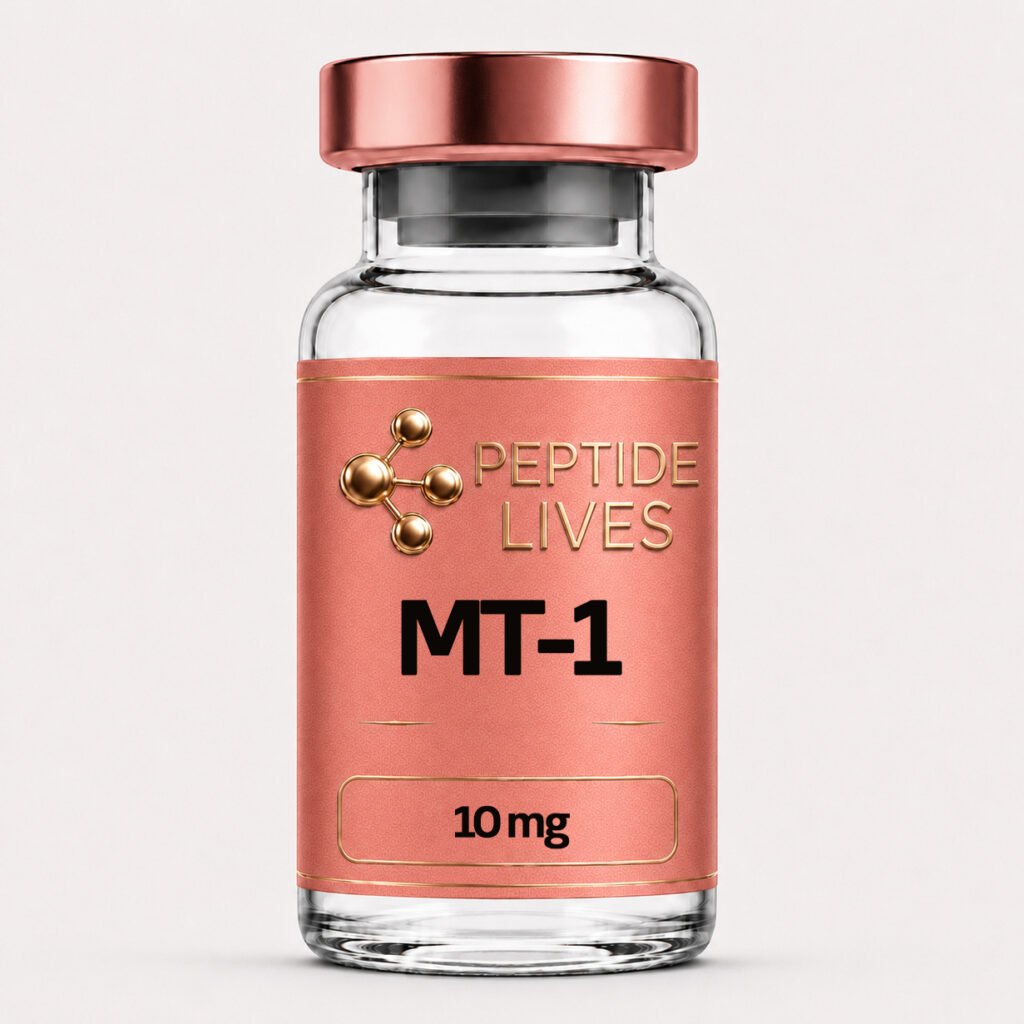
Description
MT-1 Technical Overview
MT-1, also known as Melanotan I or Afamelanotide, is a synthetic 13-amino-acid analogue of alpha-melanocyte-stimulating hormone (α-MSH). Its structure contains norleucine at position 4 and D-phenylalanine at position 7, distinguishing it from the native hormone.
MT-1 belongs to the melanocortin peptide family and is investigated primarily for its interaction with melanocortin receptors, particularly melanocortin-1 receptor (MC1R). MC1R activation is associated with intracellular cyclic AMP signaling and the regulation of melanogenesis in melanocytes.
Research involving Afamelanotide has examined melanocortin receptor pharmacology, eumelanin synthesis, pigment regulation, and cellular responses to ultraviolet radiation. The compound’s pharmacological profile differs from that of MT-2, which is a separate synthetic melanocortin analogue.
Compound Specifications
| Property | Value |
|---|---|
| Compound Name | MT-1 |
| Alternative Names | Melanotan I, Afamelanotide |
| CAS Number | 75921-69-6 |
| PubChem CID | 16154396 |
| Molecular Formula | C78H111N21O19 |
| Molecular Weight | 1646.8 g/mol |
| Amino Acid Sequence | Ac-Ser-Tyr-Ser-Nle-Glu-His-D-Phe-Arg-Trp-Gly-Lys-Pro-Val-NH2 |
| Sequence Length | 13 amino acid residues |
| Peptide Classification | Synthetic α-MSH analogue |
| Primary Research Receptor | MC1R |
| Structural Modifications | Norleucine-4 and D-phenylalanine-7 |
| Source | Synthetic |
| Vial Content | 10mg |
| Research Category | Melanocortin Research |
Specifications refer to the Afamelanotide parent peptide. Counterions and formulation components may change the overall composition of the supplied material.
Storage and Handling
- Store according to the manufacturer’s validated stability recommendations.
- Keep the research material protected from moisture and direct light.
- Minimize unnecessary temperature fluctuations.
- Use appropriate laboratory procedures to avoid contamination.
- Consult batch-specific documentation for formulation-dependent stability.
Lyophilized Format
MT-1 may be manufactured in lyophilized form. Freeze-drying reduces moisture content and can support peptide stability under appropriate storage conditions.
The physical form and stability characteristics of the supplied preparation depend on its formulation and packaging.
Research Use Disclaimer
MT-1 is described here as a laboratory research material and is not intended for human or veterinary administration.
Afamelanotide is the active ingredient in an FDA-approved prescription implant for a specific medical indication. That approval does not extend to this research preparation or establish its equivalence to an approved pharmaceutical product.
Frequently Asked Questions
What Is MT-1 10mg?
MT-1 10mg is a research presentation of Melanotan I, a synthetic 13-amino-acid analogue of alpha-melanocyte-stimulating hormone.
What Is the Amino Acid Sequence of MT-1?
The sequence is Ac-Ser-Tyr-Ser-Nle-Glu-His-D-Phe-Arg-Trp-Gly-Lys-Pro-Val-NH2.
What Is the Molecular Weight of MT-1?
The parent peptide has a molecular weight of approximately 1646.8 g/mol.
Which Receptor Is Associated With MT-1?
MT-1 is investigated primarily for its activity at the melanocortin-1 receptor, MC1R.
How Does MT-1 Differ From MT-2?
MT-1 is a 13-amino-acid linear analogue of α-MSH, while MT-2 is a shorter cyclic melanocortin analogue with a different receptor activity profile.
What Research Areas Involve MT-1?
Research includes melanocortin receptor signaling, melanocyte biology, pigment synthesis, and cellular responses to ultraviolet radiation.
Research Overview
Melanotan I was developed through modifications of the naturally occurring α-MSH sequence. The introduction of norleucine and D-phenylalanine helped establish a synthetic melanocortin analogue with altered biological stability and receptor-associated activity.
Research has investigated the relationship between melanocortin receptor activation and melanin production. Studies involving Afamelanotide have also examined pigmentation-related physiological responses in humans.
MC1R Signaling Research
MC1R is a G protein-coupled receptor expressed by melanocytes. Its activation can stimulate adenylyl cyclase and increase intracellular cyclic AMP.
These signaling events contribute to the regulation of pigmentation-associated gene expression.
Melanogenesis Research
Experimental investigations have examined melanocortin-mediated regulation of eumelanin production.
MC1R-associated signaling influences pathways involving MITF and melanogenic enzymes, including tyrosinase.
Ultraviolet Response Research
Research involving melanocortin signaling has explored relationships between pigmentation and cellular responses to ultraviolet radiation.
Melanogenesis is one component of the skin’s biological response to environmental UV exposure.
Melanocortin Analogue Research
MT-1 is relevant to structure-activity studies comparing α-MSH with synthetic melanocortin analogues.
Researchers investigate how defined amino acid substitutions influence receptor interaction and peptide activity.
Research Applications
| Research Area | In Vitro Application |
|---|---|
| MC1R Signaling | Melanocortin receptor activation assays |
| Melanogenesis | Melanocyte pigmentation pathway studies |
| cAMP Signaling | Intracellular second-messenger measurements |
| Peptide Chemistry | α-MSH analogue structure-activity research |
| UV Response | Experimental pigmentation-related cellular models |
References
- PubChem — Afamelanotide, CID 16154396. Chemical structure and molecular properties.
- Dorr RT, Lines R, Levine N, et al. (1996). Evaluation of Melanotan-II, a Superpotent Cyclic Melanotropic Peptide in a Pilot Phase-I Clinical Study. Life Sciences. Research on a related, structurally distinct melanocortin analogue.
- Afamelanotide and Melanocortin Receptor Research — PubMed.
Certificate of Analysis (COA)
Researchers should review available batch-specific documentation confirming the peptide’s identity, complete sequence, purity, and actual content.
For information about available analytical documentation, contact Peptide Lives.

Reviews
There are no reviews yet.