

Description
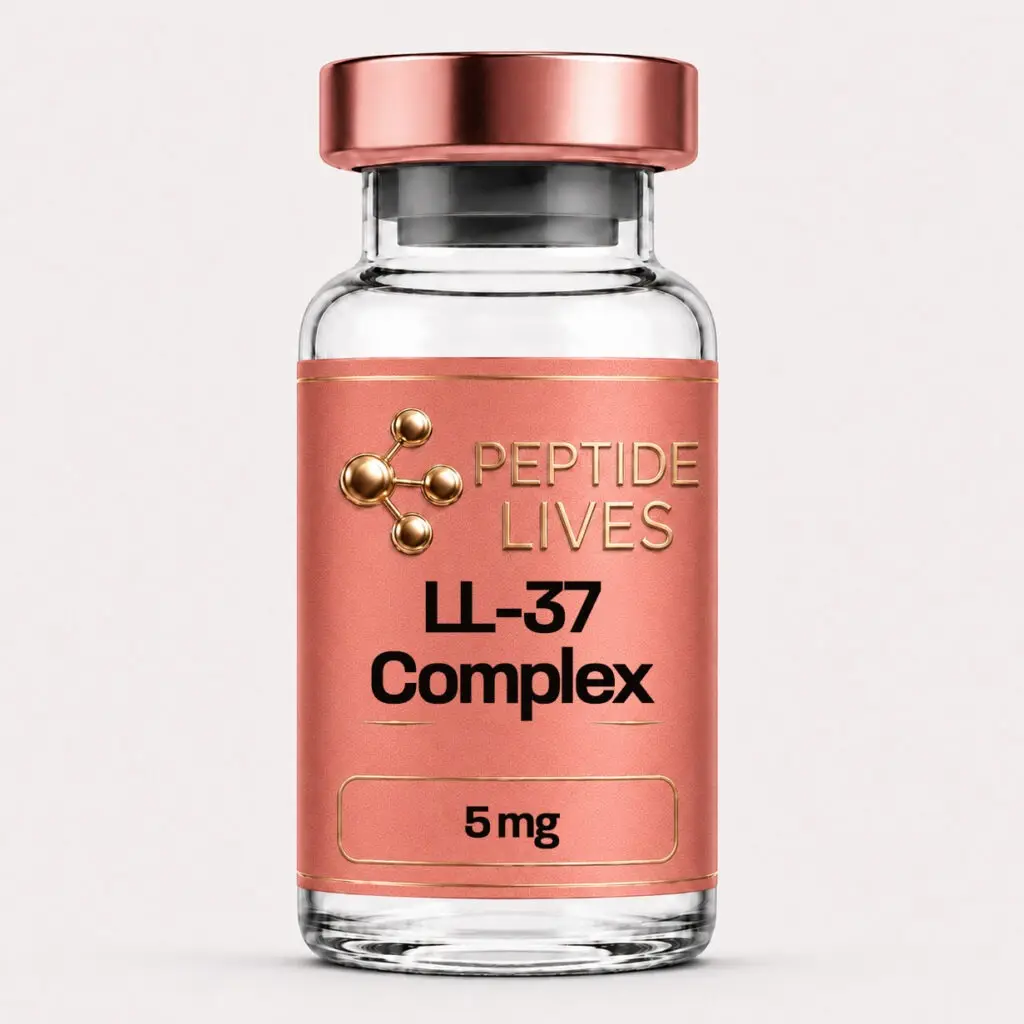
LL-37 Complex Technical Overview
LL-37 is a naturally occurring antimicrobial peptide consisting of 37 amino acid residues. It is generated through proteolytic processing of the human cathelicidin precursor protein hCAP18, encoded by the CAMP gene.
LL-37 has been investigated in research involving antimicrobial activity, membrane interactions, immune signaling, and host defense mechanisms.
The designation “LL-37 Complex” does not identify a unique molecular formulation. A complex may contain LL-37 together with other components, and those additional ingredients can alter the preparation’s experimental properties.
Compound Specifications
| Property | Value |
|---|---|
| Product Name | LL-37 Complex |
| Principal Peptide | LL-37 |
| Parent Protein | Human cathelicidin hCAP18 |
| Related Gene | CAMP |
| LL-37 Amino Acid Sequence | LLGDFFRKSKEKIGKEFKRIVQRIKDFLRNLVPRTES |
| Sequence Length | 37 residues |
| Classification | Cationic antimicrobial peptide |
| Complete Complex Composition | Formulation-specific |
| Vial Content | Not specified in product title |
| Research Category | Innate Immunity and Microbiology Research |
Storage and Handling
- Use manufacturer-recommended stability conditions.
- Protect the preparation from moisture and contamination.
- Follow appropriate laboratory biosafety procedures.
- Account for possible peptide interactions with other formulation ingredients.
Lyophilized Format
LL-37 may be produced in lyophilized form. A complex containing additional components requires formulation-specific stability information.
Research Use Disclaimer
LL-37 Complex is described for laboratory research only. It is not FDA-approved as a treatment for infection, inflammation, or any other medical condition. Not intended for human or veterinary administration.
Frequently Asked Questions
What Is LL-37?
LL-37 is a 37-residue human cathelicidin-derived antimicrobial peptide.
What Is LL-37 Complex?
A commercial preparation associated with LL-37 whose complete composition depends on the formulation.
What Is the Parent Protein?
hCAP18, encoded by the CAMP gene.
What Research Areas Involve LL-37?
Microbial membrane biology, antimicrobial peptide interactions, and innate immune signaling.
Is LL-37 an Antibiotic Approved by the FDA?
No. LL-37 is not an FDA-approved antibiotic.
LL-37 Research Overview
LL-37 is a component of the human innate immune system and has been investigated for its interactions with microbial and mammalian cell membranes.
Antimicrobial Research
In vitro investigations have examined LL-37 activity against selected bacterial and fungal organisms under defined laboratory conditions.
Membrane Interaction Research
The peptide’s cationic and amphipathic characteristics are relevant to studies of peptide-membrane interactions.
Immune Signaling Research
Experimental studies have investigated relationships between LL-37 and cellular inflammatory signaling pathways.
Research Applications
| Research Area | In Vitro Application |
|---|---|
| Microbiology | Antimicrobial activity assays |
| Membrane Biology | Peptide-lipid interaction studies |
| Innate Immunity | Immune-cell response assays |
| Formulation Science | Multi-component stability studies |
References
- Vandamme D, Landuyt B, Luyten W, Schoofs L. (2012). A comprehensive summary of LL-37, the factotum human cathelicidin peptide. Cellular Immunology. View publication.
- Turner J, Cho Y, Dinh NN, Waring AJ, Lehrer RI. (1998). Activities of LL-37, a cathelin-associated antimicrobial peptide of human neutrophils. Antimicrobial Agents and Chemotherapy. View publication.
Certificate of Analysis (COA)
Analytical documentation should identify LL-37 and every additional component of the complex, including their respective quantities and purity measurements.
For available product documentation, contact Peptide Lives.

Reviews
There are no reviews yet.